
Pediatric Neurosurgery – Stroke Surgery in Hyderabad, India
What is stroke in children?
A stroke happens when the blood supply to a part of the brain is suddenly disturbed, either because a blood vessel is blocked or because it bleeds. Stroke is often thought of as a disease of older adults, but it does occur in children and infants, and even before birth. Because the diagnosis is not expected in a child, stroke symptoms in children are frequently missed or mistaken for other conditions in the first few hours, which is exactly the window in which treatment makes the biggest difference. Any child at a good paediatric neurosurgery hospital in Hyderabad with sudden weakness, facial drooping, or difficulty speaking should be evaluated for stroke without delay.
Who treats stroke in children?
A paediatric neurosurgeon manages the surgical side of childhood stroke, working closely with a paediatric neurologist, an intensive care team, and a rehabilitation team. When a stroke is caused by a problem in the blood vessels of the brain, such as a blockage, weak vessel, or abnormal connection between arteries and veins, the neurosurgeon is often the specialist who decides whether surgery is needed to restore blood flow, stop bleeding, or relieve pressure inside the skull. Choosing an established centre for paediatric neurosurgery in Hyderabad matters here, because childhood stroke needs round-the-clock imaging and a team experienced in operating on small, actively growing blood vessels.
Causes of stroke in children
Causes of stroke in children are different from the causes seen in adults, where high blood pressure and cholesterol are the usual factors.
- Moyamoya disease: A progressive narrowing of the arteries at the base of the brain, causing the body to form a fragile network of small vessels that can block blood flow or bleed. This is one of the most common surgical causes of stroke in children.
- Congenital heart disease: Certain heart conditions present from birth can allow a clot to travel from the heart to the brain, blocking a vessel there.
- Blood clotting disorders: Some children are born with, or develop, conditions that make their blood clot too easily, increasing the risk of a blocked vessel in the brain.
- Arteriovenous malformation: An abnormal tangle of blood vessels present from birth that can rupture and bleed into the brain.
- Infections: Certain infections, including those of the brain lining or the blood vessels themselves, can trigger inflammation and artery narrowing.
- Sickle cell disease: Abnormally shaped blood cells can block small and medium vessels in the brain, making this an important cause of stroke in children with the condition.
- Head and neck trauma: Injury to the arteries in the neck, even from a relatively minor fall or sports injury, can occasionally lead to a clot that travels to the brain.
- Perinatal stroke: Stroke can occur around the time of birth, often related to clotting problems, infection, or complications during delivery, and may only become apparent months later as a delay in using one side of the body.
Stroke symptoms in children
Stroke symptoms in children can appear suddenly, but they can also be subtle, especially in younger children who cannot describe what they are feeling.
- Sudden weakness or numbness: Sudden weakness of the face, arm, or leg on one side of the body is the most recognisable warning sign.
- Facial drooping: One side of the face may droop, or the smile may look uneven.
- Difficulty speaking or understanding: Slurred speech, trouble finding words, or difficulty following simple instructions can appear within minutes.
- Sudden severe headache: A headache that comes on abruptly and is far worse than any headache the child has had before, sometimes with vomiting, can point to bleeding in the brain.
- Loss of balance or coordination: Sudden unsteadiness, difficulty walking, or clumsiness that was not present before.
- Seizures: A first-time seizure, particularly with weakness on one side afterwards, can be a presenting sign of stroke in a child.
- Vision changes: Sudden blurring, double vision, or loss of vision in part of the field of view.
- Altered alertness: Unusual drowsiness or difficulty waking the child fully.
Pediatric stroke symptoms in infants and younger children
Pediatric stroke symptoms are often less obvious in infants and toddlers than in older children and adults, which is why a delay in diagnosis is common at this age.
- Infants: Seizures, unusual sleepiness, poor feeding, or noticeably favouring one hand well before the age at which hand preference normally develops can be the only clues.
- Toddlers and young children: Sudden clumsiness, dragging of one leg, a new preference for one hand, or a regression in walking or speech that was already achieved should raise suspicion.
- Recurrent events: In conditions such as moyamoya disease, children may have repeated brief episodes of weakness or speech difficulty, often triggered by crying, fever, or exertion, before a larger stroke occurs.
When to seek emergency care
- Sudden weakness or drooping on one side of the face or body, however brief it seems.
- Slurred speech or sudden difficulty understanding others.
- A sudden, severe headache unlike any the child has had before, especially with vomiting or a change in alertness.
- A first seizure, particularly if it is followed by weakness on one side.
- Sudden loss of balance, vision changes, or difficulty walking.
- Any brief episode of weakness or speech difficulty that resolves on its own should still be reported urgently, since it can be an early warning sign of a bigger stroke to follow, particularly in children with moyamoya disease or heart conditions.
Acting within the first hour of any of these symptoms gives the child the best chance of a good recovery, so the family should go straight to a centre equipped for paediatric neurosurgery in Hyderabad rather than waiting to see if the symptoms settle.
Diagnosis of stroke in children
- Clinical examination: A focused neurological examination helps identify which side and which function is affected, and how severe the stroke is.
- MRI scan: MRI, including specific sequences that look at the blood vessels, is the main investigation to confirm a stroke, show its extent, and identify whether it was caused by a blockage or bleeding.
- CT scan: CT is used in an emergency, particularly to quickly rule out bleeding in the brain when a child arrives with sudden symptoms.
- Vascular imaging: A CT angiogram, MR angiogram, or a catheter-based angiogram maps the blood vessels of the brain in detail, which is essential for planning surgery in conditions such as moyamoya disease or an arteriovenous malformation.
- Cardiac evaluation: An echocardiogram and heart rhythm monitoring are done to look for a source of clot in the heart.
- Blood tests: Tests for clotting disorders, sickle cell disease, and markers of infection or inflammation help identify an underlying cause.
Treatment of stroke in children
Treatment depends on the cause of the stroke. Where a clot has blocked a vessel, medicines to prevent further clotting, and in selected cases a procedure to remove the clot, are used within a narrow time window. Where the stroke has been caused by bleeding, the focus shifts to controlling the bleeding and relieving pressure inside the skull.
Surgery has a defined role in several causes of childhood stroke. In moyamoya disease, a revascularisation surgery is performed to create a new blood supply to the starved areas of the brain, reducing the risk of further stroke over the years ahead. In an arteriovenous malformation that has bled, surgery, or in some cases a combination of surgery with other techniques, is used to remove or close off the abnormal vessels and prevent another bleed. When a stroke has caused significant brain swelling, a decompressive surgery to relieve pressure inside the skull can be lifesaving. Throughout treatment, close coordination between the paediatric neurosurgeon, neurologist, and intensive care team is what allows a growing brain to recover as much function as possible.
Recovery and rehabilitation after stroke
Children generally have a greater capacity than adults to recover function after a stroke, because the developing brain can often reorganise itself around the area of injury. Recovery is not automatic, however, and depends heavily on structured rehabilitation started early and continued consistently.
- Physiotherapy: Helps regain strength, balance, and coordination in the affected arm or leg.
- Occupational therapy: Supports the child in relearning everyday tasks and fine motor skills.
- Speech and language therapy: Addresses difficulties with speech, language, and swallowing where the stroke has affected these areas.
- School reintegration: Many children need a gradual, supported return to school, with input from teachers on any learning difficulties that follow the stroke.
- Long-term follow-up: Regular review with the paediatric neurosurgery team, including repeat imaging where indicated, is needed to watch for recurrence, especially in conditions such as moyamoya disease that can progress over time.
Precautions and prevention
- Manage underlying conditions: Sickle cell disease, congenital heart disease, and clotting disorders should be under regular specialist care to reduce stroke risk.
- Do not dismiss brief symptoms: A short episode of weakness or speech trouble that resolves on its own still needs urgent evaluation.
- Keep a symptom diary in known vascular conditions: Families of children with moyamoya disease or a known malformation should note the frequency and triggers of any brief episodes and report them promptly.
- Attend scheduled scans: Periodic vascular imaging helps track conditions such as moyamoya disease before a major stroke occurs.
- Support recovery consistently: Continuing physiotherapy and other therapies even after visible improvement helps consolidate the child’s recovery.
Stroke in a child is uncommon, but the earlier it is recognised, the better the outcome. Because causes of stroke in children range from heart and blood conditions to abnormalities of the brain’s own blood vessels, a thorough evaluation at a well-equipped pediatric neurosurgery hospital in Hyderabad is essential to find the exact cause and choose the right treatment. Prompt recognition of stroke symptoms in children, followed by urgent specialist care, gives a child the best possible chance of recovering strength, speech, and normal development.
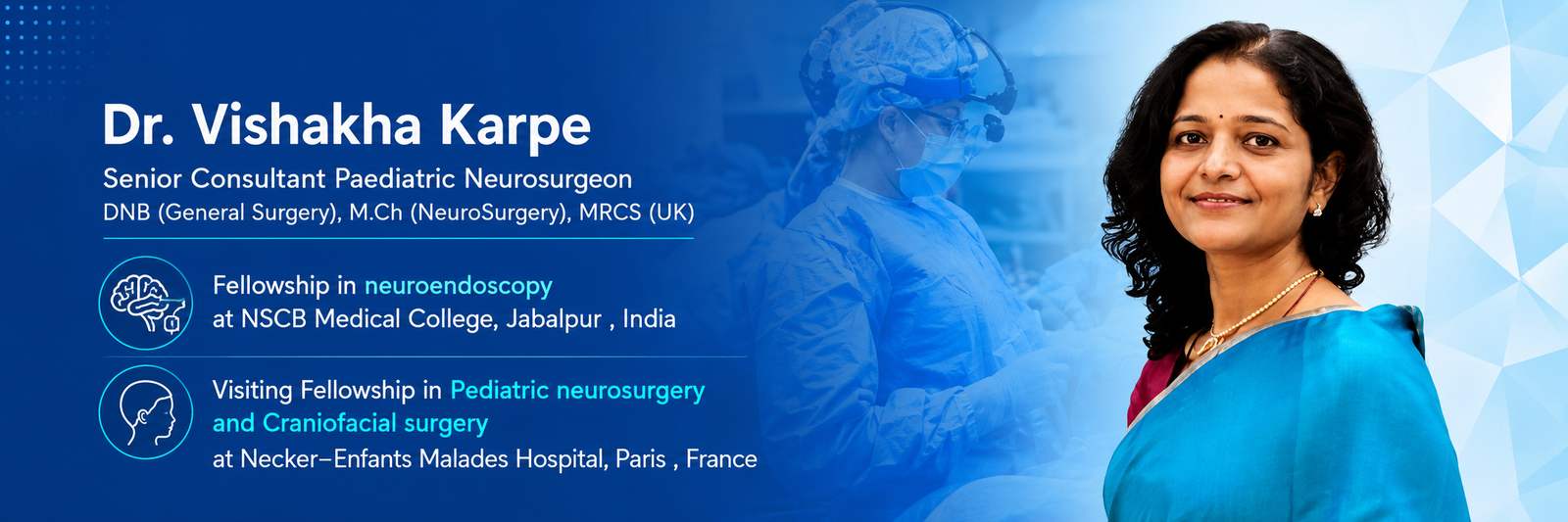
Proficiency of Dr Vishaka:
- Hydrocephalus (increased fluid in the brain) Treatment:
Endoscopic third ventriculostomy and CSF diversion (VP shunt) , neuroendoscopic procedures for complex hydrocephalus. - Craniosynostosis (abnormal head shape due to untimely cranial sutures fusion) :
- Treatment – Helmet therapy , endoscopic and open surgery.
- Spinal dysraphisms(Spina Bifida)-
(spinal abnormalities present since birth) – surgical repair - Encephalocele repair surgery.
- Vascular and stroke surgeries:
revascularization surgeries for moya moya disease, emergency surgery for stroke - Pediatric brain and spine tumour surgeries.
- Pediatric brain and spine infection surgeries:
Endoscopic and open surgeries for brain and spine infections. - Pediatric traumatic brain and spinal injury.
- Antenatal counselling for congenital fatal neurosurgical conditions.
Dr Vishakha Karpe M.B.B.S, DNB (AIIMS) New Delhi, M.Ch (IPGMER SSKM) Member of “The Royal College of Surgeons, Edinburgh” (U.K.) is a highly competent and one of the best pediatric neurosurgeons in Hyderabad, Telangana with 13 years of experience, is among the topmost pediatric neurosurgeons in the Rainbow group of hospitals at Banjara Hills and Hyder Nagar.