
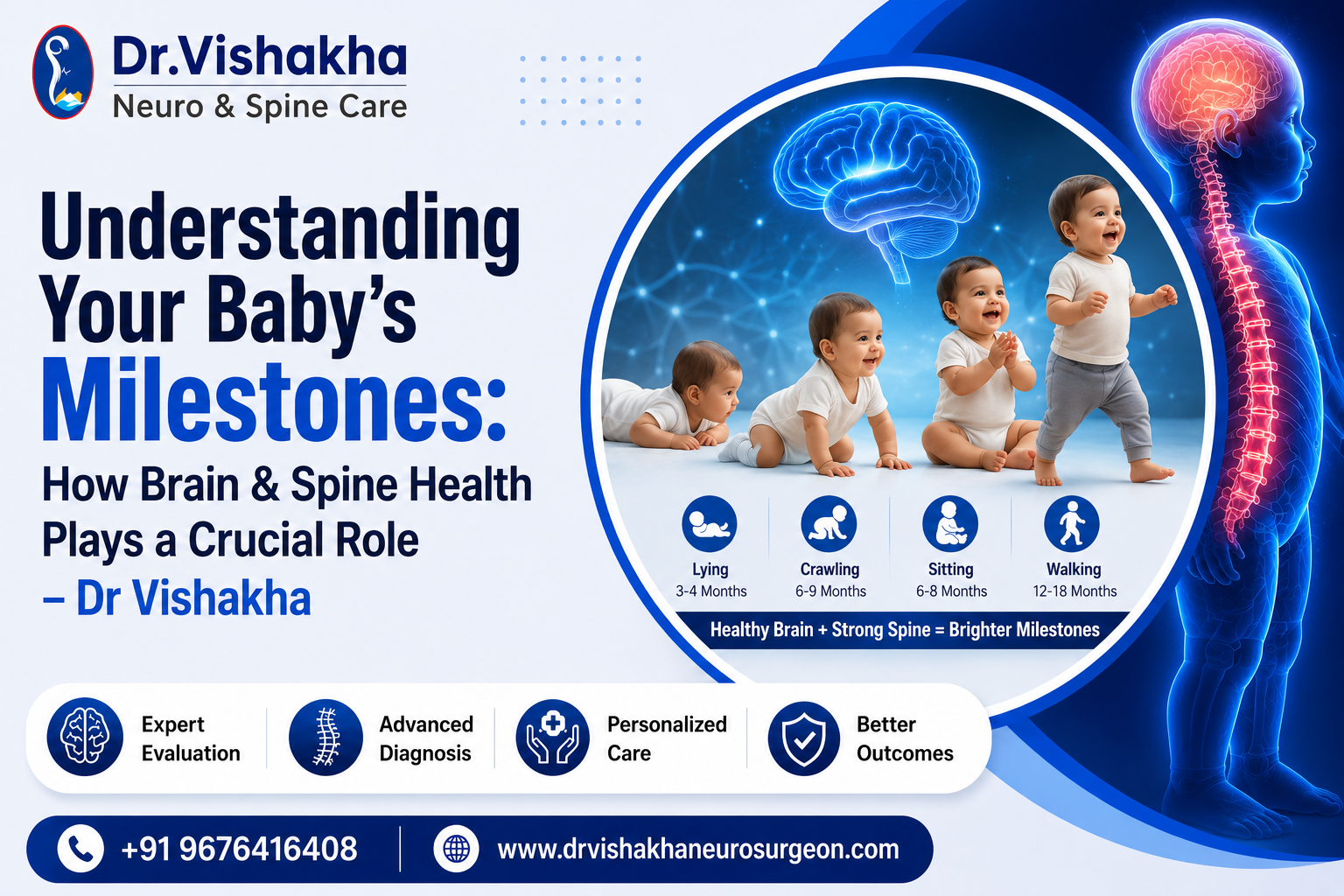
Baby milestones — like holding the head up, sitting, crawling, and talking depend heavily on healthy brain and spinal cord development. The nervous system acts like the body’s wiring, sending signals that let muscles move, senses sharpen, and thoughts form. When something disrupts this wiring, whether it’s a structural issue in the spine or a hiccup in baby brain development, milestones can lag. Spotting a developmental delay in babies early and consulting a paediatric neurosurgeon promptly can make a world of difference to long-term outcomes. This guide walks you through causes, warning signs, and questions worth asking your doctor.
Understanding the Condition
Think of your baby’s nervous system as the control tower of an airport. The brain gives instructions, the spinal cord relays them, and the body carries them out. When this control tower runs smoothly, infant developmental milestones unfold on a fairly predictable timeline. When there’s static in the signal, things can get delayed or go off track.
Causes — Why Do These Happen?
Several factors can influence a child’s developmental milestones, including:
- Genetic conditions are passed down through families
- Complications during pregnancy or birth, such as reduced oxygen supply
- Premature birth, which gives the brain less time to mature in the womb
- Congenital structural issues like spina bifida or craniosynostosis
- Infections affecting the brain or spinal cord early in life
- Injuries to the head or spine during delivery or infancy
Sometimes the cause is obvious right from birth. Other times, it only becomes clear as the weeks go by, and certain skills simply don’t show up on schedule.
Types
Delays or disruptions generally fall into a few buckets:
| Type | What It Affects |
|---|---|
| Motor delays | Sitting, crawling, walking |
| Speech and language delays | Babbling, first words |
| Cognitive delays | Problem-solving, memory |
| Social-emotional delays | Bonding, eye contact, response to name |
Some babies show a delay in just one area; others show a mix. That’s exactly why infant brain development and baby spine health are assessed together. A spinal issue can just as easily show up as a “motor delay” as a brain-related one can.
Conditions We Often See
In paediatric neurosurgery clinics, a handful of conditions come up again and again:
- Hydrocephalus — excess fluid building up around the brain
- Spinal dysraphism (Spina Bifida) — incomplete closure of the spine at birth
- Craniosynostosis — early fusion of skull bones, changing head shape
- Encephalocele — a sac-like bulge of brain tissue through a skull gap
- Brain and spine infections or tumours
- Moyamoya disease — a rare blood vessel condition affecting brain circulation
Each of these can quietly influence how a baby reaches, or misses, key milestones.
What Happens Next?
If a paediatrician or parent notices something’s off, the usual path looks like this:
- A detailed developmental history and physical exam
- Imaging (MRI or ultrasound) to look at the brain and spine structure
- Referral to a specialist in pediatric neurology or paediatric neurosurgery
- A tailored treatment plan — which might include surgery, therapy, or simply close monitoring
Early action here isn’t about panicking. It’s about giving your baby the best possible runway for growth. Early childhood development is remarkably adaptable — the sooner an issue is caught, the more room there is to correct course.
Questions to Ask Your Specialist
Walking into a specialist’s office can feel overwhelming. Bring a notebook (or your phone) and ask:
- What exactly is causing my baby’s delay or condition?
- Is this something that needs surgery, therapy, or just time?
- What milestones should I be watching for over the next few months?
- Are there risks if we wait versus treat now?
- What does recovery or follow-up care look like?
- Will this affect my baby long-term?
No question is too small. A good specialist will welcome every single one.
FAQs
- What are the most common baby milestones parents should track?
Head control by 3 months, sitting by 6 months, crawling by 9 months, and first words around 12 months are common markers of baby developmental milestones, though every baby has their own pace.
- When should I worry about a developmental delay in babies?
If your baby misses a milestone by several months or loses a skill they’d already gained, it’s worth a check-up rather than a wait-and-watch approach.
- Can spine problems affect brain development?
Yes. The spine and brain are directly connected through the nervous system, so a spinal issue can disrupt signals travelling to and from the brain, affecting movement and coordination.
- Is craniosynostosis dangerous for my baby?
It can restrict brain growth space if untreated, which is why early diagnosis and, when needed, surgical correction matter.
- How is hydrocephalus treated in babies?
Common approaches include endoscopic third ventriculostomy or a CSF shunt to relieve fluid pressure around the brain.
- Does early treatment really improve outcomes?
Absolutely. The brain and spine are still forming rapidly in infancy, so early, appropriate treatment often leads to significantly better long-term function.
Proficiency of Dr Vishakha – Neurosurgeries Expertise
Hydrocephalus (increased fluid in the brain): The procedure involves an endoscopic third ventriculostomy and CSF diversion (VP shunt) to treat complex hydrocephalus.
Craniosynostosis (abnormal head shape due to premature cranial suture fusion) surgeries: Helmet therapy is a technique that is used in both endoscopic and open surgery.
Spinal dysraphisms(Spina Bifida)– (spinal abnormalities present by birth) – surgical repair
Encephalocele repair surgery.
Vascular conditions and stroke surgeries: revascularisation surgeries for moyamoya disease.
Pediatric brain and spine tumour surgeries.
Pediatric brain and spine infection surgeries: Endoscopic and open surgeries for brain and spine infections.
Pediatric traumatic brain and spinal injury.
Antenatal counselling for congenital fatal neurosurgical conditions.
Conclusion
Watching your baby grow is one of life’s quiet joys and also, understandably, a source of worry when things don’t seem to go quite to plan. Remember that baby milestones aren’t a race. But when a delay does show up, understanding the role of baby brain development and spinal health can help you act early and confidently. With the right specialist by your side, most conditions are manageable, and many babies go on to thrive.
Related treatment pages:
- Hydrocephalus: https://drvishakhaneurosurgeon.com/hydrocephalus/
- Craniosynostosis: https://drvishakhaneurosurgeon.com/craniosynostosis/
- Spina Bifida: https://drvishakhaneurosurgeon.com/spina-bifida/
- Brain and Spine Tumours: https://drvishakhaneurosurgeon.com/brain-and-spine-tumors/
Other blog posts:
- Is your baby’s soft spot normal? Here’s how to tell: https://drvishakhaneurosurgeon.com/is-your-babys-soft-spot-normal-heres-how-to-tell-dr-vishakha-explains/
- Brain or spine issues spotted on your anomaly scan? Please take a moment to read this: https://drvishakhaneurosurgeon.com/brain-or-spine-issues-spotted-on-your-anomaly-scan-please-take-a-moment-to-read-this/
Book a Consultation
If your baby has missed a milestone or you simply want peace of mind, don’t wait. Book a consultation with Dr Vishakha, the best paediatric neurosurgeon in Hyderabad, today.
📞 Call: +91 8618978597 or +91 9676416408 🌐 Visit: drvishakhaneurosurgeon.com