
Quick Answer Summary
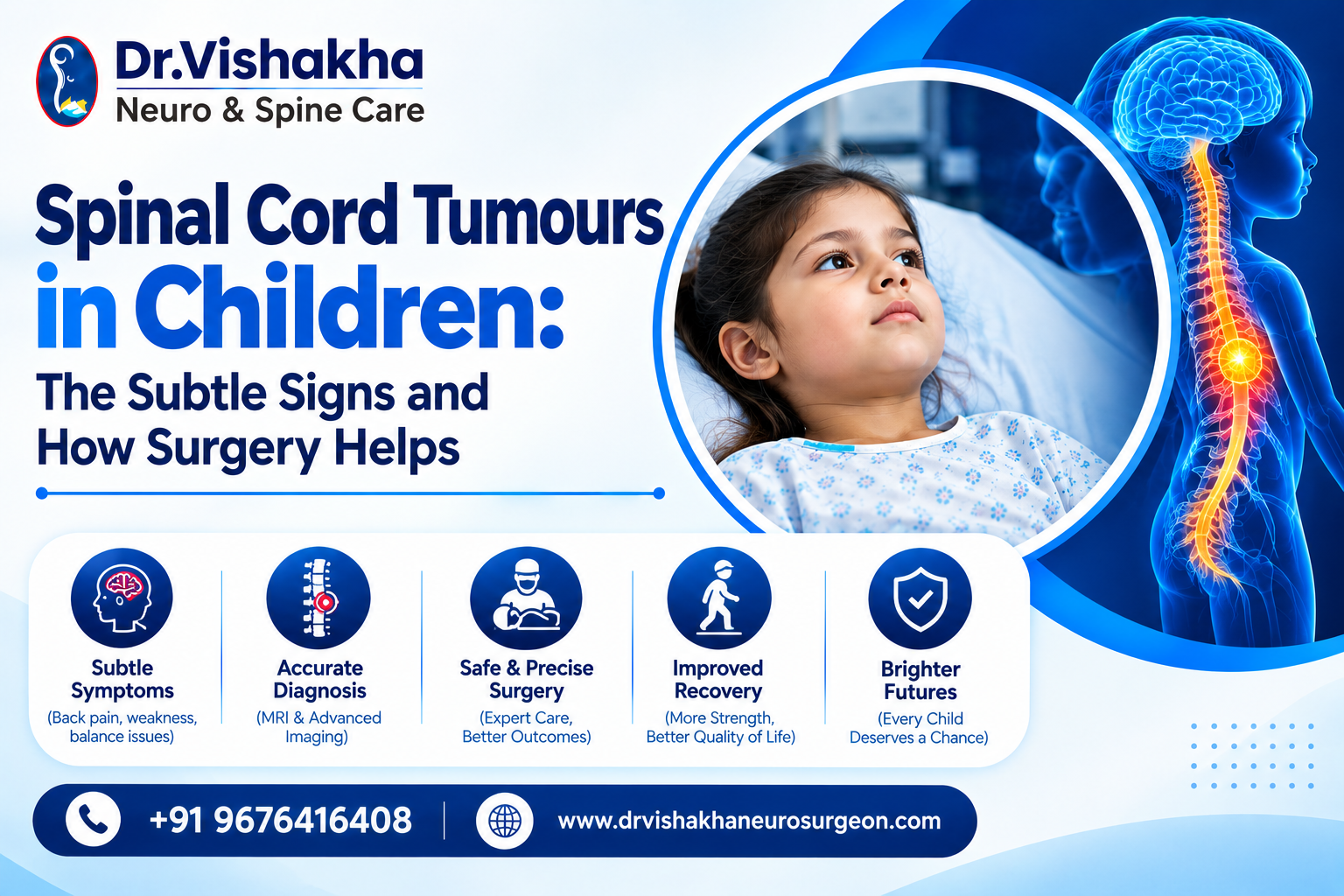
Spinal cord tumours in children are rare growths that develop within or around the spinal cord and may compress the nerves responsible for movement, sensation, and bladder and bowel control. Early symptoms are often subtle and may be mistaken for common childhood complaints. Clinically significant signs include back pain in children at night, progressive walking difficulty in children, altered bladder or bowel function, and a new spinal curvature in children. Magnetic resonance imaging (MRI) is the investigation of choice. Advances in microsurgical techniques and neuromonitoring have made spinal cord tumour surgery in children considerably safer, and timely intervention significantly improves neurological outcomes.
Spinal Cord Tumours in Children
The spinal cord is the principal pathway for nerve signals travelling between the brain and the rest of the body. It lies within the spinal canal, a narrow bony channel with limited capacity to accommodate any additional mass. As a result, even a small lesion can exert pressure on the neural tissue and produce symptoms.
Spinal cord tumours may be benign or malignant. A benign diagnosis does not necessarily imply a benign clinical course, since compression alone can cause a progressive neurological deficit. In children, management must also account for the growing spine, as both the tumour and its treatment can influence spinal alignment and development.
Because spinal cord tumours in children are uncommon, diagnosis is often delayed. Early recognition and referral remain the most important factors in preserving neurological function.
Causes and Risk Factors
In the majority of cases, no definite cause is identified. These tumours are not linked to parental actions, diet, or minor injuries sustained during play.
Recognised risk factors include:
- Genetic syndromes, including neurofibromatosis type 1 and type 2 (NF1 and NF2) and Von Hippel-Lindau syndrome
- A family history of nerve sheath or central nervous system tumours
- Prior radiation exposure to the spinal region
- Metastatic spread from other childhood cancers, such as neuroblastoma
Children with a known genetic predisposition may benefit from periodic clinical surveillance, as advised by their specialist.
Types of Pediatric Spinal Cord Tumors
The types of pediatric spinal cord tumors are classified according to their anatomical relationship with the spinal cord and the dura, the protective membrane that surrounds it.
| Location | Anatomical position | Common examples in children |
| Intramedullary | Within the substance of the spinal cord | Astrocytoma, ependymoma |
| Intradural extramedullary | Within the dura but outside the spinal cord | Schwannoma, neurofibroma, meningioma |
| Extradural | Outside the dura, often involving the vertebral bones | Neuroblastoma, Ewing sarcoma, osteoblastoma |
Classifying the types of pediatric spinal cord tumors guides the surgical approach, the need for additional therapy, and the expected prognosis.
Symptoms and Warning Signs
Pediatric spinal cord tumor symptoms typically develop gradually and may be non-specific in the early stages. Young children may be unable to describe their symptoms clearly, which further contributes to delays in diagnosis.
Clinically important features include:
- Back pain in children at night, particularly pain that disturbs sleep or worsens when lying down
- Progressive walking difficulty in children, including limping, frequent falls, or an unsteady gait
- Weakness, numbness, or tingling in the arms or legs
- A new or rapidly progressing spinal curvature in children (scoliosis)
- Neck or back stiffness, or an abnormal head posture (torticollis)
- Bladder or bowel dysfunction, including new-onset bed-wetting, urinary retention, or constipation
- In infants and toddlers, irritability, loss of previously achieved motor milestones, or reluctance to stand or walk
The following table outlines features that help differentiate harmless musculoskeletal pain from symptoms that warrant further investigation.
| Typically harmless | Requires prompt evaluation |
| Pain related to activity that resolves with rest | Pain that wakes the child from sleep |
| Discomfort lasting a few days | Pain persisting beyond two to three weeks |
| Normal gait and coordination | A new limp, falls, or limb weakness |
| Stable posture | Progressive spinal curvature |
Any persistent symptoms of tumour on spine should prompt a medical review rather than a period of watchful waiting.
Diagnosis of Spinal Cord Tumours
Evaluation begins with a detailed clinical history and a thorough neurological examination assessing muscle strength, reflexes, sensation, coordination, and gait.
An MRI of the spine with contrast is the gold-standard investigation, as it provides detailed images of the spinal cord and surrounding structures without exposure to radiation. Younger children may require sedation during the scan. A computed tomography (CT) scan may be used to assess bone involvement, and brain imaging is sometimes performed at the same time. A definitive diagnosis is made by examining a tissue sample (histopathology), which is usually obtained during surgery.
When symptoms of tumour on spine are present, early consultation with an experienced spinal cord tumour specialist in Hyderabad is advisable, as the duration of nerve compression strongly influences the degree of functional recovery.
Treatment Options for Spinal Cord Tumours in Children
Spinal cord tumour treatment is individualised according to the tumour type, location, and extent, as well as the child’s age and neurological status. Care is ideally coordinated by a multidisciplinary team that includes a pediatric neurosurgeon, a pediatric oncologist, a radiologist, and rehabilitation specialists.
| Treatment | Indication |
| Surgical removal | First-line treatment for most tumours, aiming for maximal safe removal |
| Chemotherapy | Specific tumour types, residual disease, or tumours that cannot be completely removed |
| Radiation therapy | Selected cases, used cautiously because of its effects on the developing spine |
| Observation | Certain slow-growing tumours without symptoms, monitored with regular imaging |
Modern spinal cord tumour surgery in children uses operating microscopes for precise dissection along natural tissue planes, along with intraoperative neurophysiological monitoring (motor and somatosensory evoked potentials) that provides real-time feedback on spinal cord function. Ultrasonic aspirators allow controlled, gradual removal of the tumour, while laminoplasty, in which the back portion of the spinal bones is replaced at the end of the procedure, reduces the risk of spinal deformity after surgery in a growing child.
Relieving pressure on the spinal cord frequently results in pain relief and the stabilisation or improvement of neurological function.
Recovery and Follow-Up Care
The hospital stay after surgery generally ranges from several days to a few weeks, depending on the complexity of the procedure and the child’s neurological condition.
Long-term care includes structured physiotherapy and occupational therapy, regular MRI scans to detect any recurrence, and periodic assessment of spinal alignment as the child grows. Psychological support for both the child and the family is an essential part of comprehensive care. Children treated for spinal cord tumours often show substantial functional recovery, and many return to school and age-appropriate activities.
What Happens Next?
Families concerned about possible symptoms should record when the symptoms began and how they have progressed; video recordings of the child walking can assist the clinical assessment. A pediatrician can determine whether imaging is needed and arrange a referral to a qualified pediatric neurosurgeon in Hyderabad or the nearest specialist centre. Families are encouraged to seek clarification on every aspect of the proposed treatment plan.
Questions to Ask Your Specialist
- What is the type and exact location of the tumour?
- Is the tumour benign or malignant?
- Is complete surgical removal possible, and what are the associated risks?
- Will chemotherapy or radiation therapy be required?
- What is the expected recovery period?
- Could the treatment affect my child’s spinal growth or alignment in the future?
- How often will follow-up scans be needed?
Frequently Asked Questions (FAQs)
- How common are spinal cord tumours in children?
They are rare and account for a small proportion of childhood brain and spinal cord tumours, which is one reason they are sometimes diagnosed late. - What are the most common pediatric spinal cord tumor symptoms?
Night-time back pain, difficulty walking, weakness in the limbs, and bladder or bowel problems are among the most frequently reported symptoms. - Is surgery always required?
Surgery is the main treatment for most tumours; however, some slow-growing tumours without symptoms may be managed with careful observation. - How safe is spinal surgery in young children?
When performed by experienced surgeons using microsurgical techniques and intraoperative neuromonitoring, spinal surgery in children has become substantially safer. - Can children walk normally again after surgery?
Many children achieve a good functional recovery, particularly when treated early and supported by structured rehabilitation. - How long does spinal cord tumour treatment take?
Recovery after surgery typically takes several weeks, while additional therapy and follow-up imaging may continue for months or years, depending on the diagnosis.
Conclusion
A child’s back pain is easy to dismiss. Usually, it is just a strain from sport or a long day at school. But when the pain wakes them at night, when their steps become unsteady, or when their posture begins to change, these are signals worth investigating rather than explaining away.
Spinal cord tumours in children are rare, but they are highly treatable when identified in time. Modern imaging enables an accurate diagnosis, and advanced microsurgical techniques, supported by real-time nerve monitoring, now allow specialists to remove these tumours with a high degree of precision and safety. With timely treatment and dedicated rehabilitation, many children regain their strength and mobility and go on to walk, run, learn, and play just as they did before.
No parent should have to wonder whether a symptom matters. If a sign persists or simply does not seem right, a consultation with an experienced pediatric neurosurgeon is the most reliable next step. Early evaluation turns uncertainty into a clear plan of action and, most importantly, gives every child the best possible chance of a healthy, active future.
Proficiency of Dr Vishakha – Neurosurgeries Expertise
Hydrocephalus (increased fluid in the brain): The procedure involves an endoscopic third ventriculostomy and CSF diversion (VP shunt) to treat complex hydrocephalus.
Craniosynostosis (abnormal head shape due to premature cranial suture fusion) surgeries: Helmet therapy is a technique that is used in both endoscopic and open surgery.
Spinal dysraphisms(Spina Bifida)– (spinal abnormalities present by birth) – surgical repair
Encephalocele repair surgery.
Vascular conditions and stroke surgeries: revascularisation surgeries for moyamoya disease.
Pediatric brain and spine tumour surgeries.
Pediatric brain and spine infection surgeries: Endoscopic and open surgeries for brain and spine infections.
Pediatric traumatic brain and spinal injury.
Antenatal counselling for congenital fatal neurosurgical conditions.
Related Links
Related treatment pages:
- Craniosynostosis: https://drvishakhaneurosurgeon.com/craniosynostosis/
- Pediatric Neurosurgery: https://drvishakhaneurosurgeon.com/pediatric-neurosurgery/
- Hydrocephalus: https://drvishakhaneurosurgeon.com/hydrocephalus/
- Antenatal Counselling: https://drvishakhaneurosurgeon.com/antenatal-counselling/
Other blog posts:
- Spina Bifida Journey: From Antenatal Diagnosis to Postnatal Repair: https://drvishakhaneurosurgeon.com/spina-bifida-journey-from-antenatal-diagnosis-to-postnatal-repair/
- Understanding Your Baby’s Milestones: How Brain & Spine Health Plays a Crucial Role: https://drvishakhaneurosurgeon.com/understanding-your-babys-milestones-how-brain-spine-health-plays-a-crucial-role-dr-vishakha/
- Is Your Baby’s Soft Spot Normal? Here’s How to Tell: https://drvishakhaneurosurgeon.com/is-your-babys-soft-spot-normal-heres-how-to-tell-dr-vishakha-explains/
Book a Consultation
Persistent back pain, changes in walking, or a progressive spinal curvature in a child should be assessed by a specialist. To schedule a consultation with Dr. Vishakha Karpe, the best pediatric neurosurgeon in Hyderabad, please contact:
Phone: +91 8618978597 | +91 9676416408
Email: neurovishakha@gmail.com
Online appointments: drvishakhaneurosurgeon.com/book-appointment