
Quick Summary
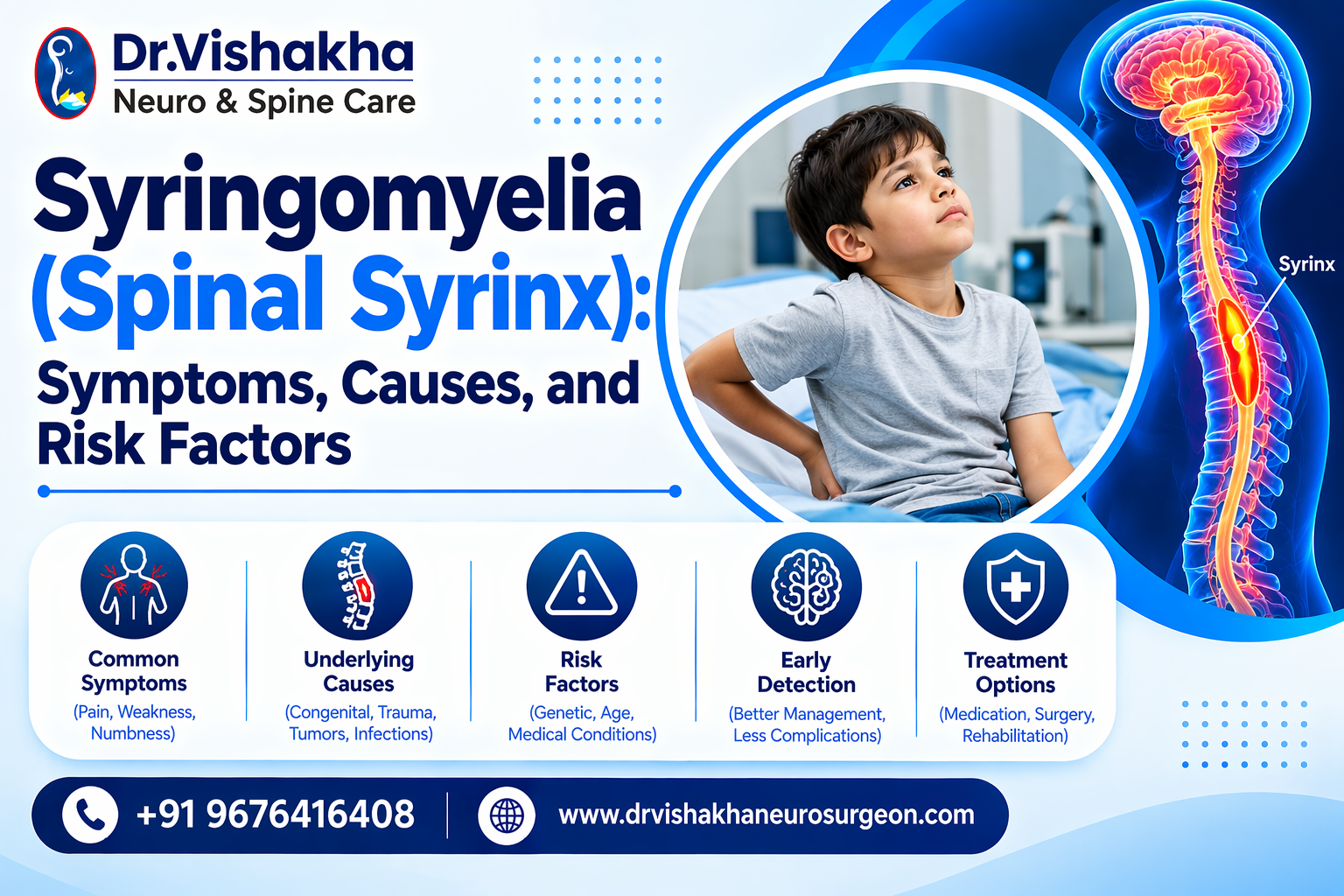
Syringomyelia is a neurological condition characterised by the formation of a fluid filled cyst in spinal cord tissue, known as a syrinx. It results from obstruction of normal cerebrospinal fluid (CSF) circulation, most commonly due to Chiari I malformation, spinal trauma, tumours, or scarring around the spinal cord. Typical clinical features include loss of pain and temperature sensation, upper limb weakness, neck or back pain, and progressive scoliosis. Syringomyelia in children is frequently identified during the evaluation of an unusual spinal curve. Management is individualised and ranges from regular MRI monitoring to surgical correction of the underlying cause.
Syringomyelia
Cerebrospinal fluid normally circulates freely around the brain and spinal cord, moving in rhythm with the heartbeat and breathing. When this flow is obstructed, abnormal pressure differences develop across the spinal cord. These pressure changes push fluid into the central portion of the cord, where it gradually collects to form a long, narrow cavity. As the syrinx enlarges, it compresses the surrounding nerve tissue, leading to progressive neurological symptoms.
Congenital and Acquired Causes
| Category | Principal Causes |
| Congenital | Chiari I malformation, spina bifida, tethered spinal cord, other spinal dysraphisms |
| Acquired | Spinal cord injury, spinal cord tumours, meningitis, scarring after surgery or bleeding (arachnoiditis) |
Congenital spinal cord abnormalities in children account for the majority of paediatric cases, with Chiari I malformation being the most frequently associated condition. Acquired syringomyelia is more commonly seen in adults and may develop months to years after the original injury or illness.
Types of Syrinx
- Communicating syrinx: Connected with the fluid spaces of the brain. It is typically associated with hydrocephalus or Chiari malformation.
- Non-communicating syrinx: Separated from the brain’s fluid spaces. It usually develops below an area of trauma, tumour, or scarring.
Signs and Symptoms
Syringomyelia symptoms in children and adults usually develop gradually and progress slowly. Recognised features include:
- Loss of pain and temperature sensation, with touch relatively preserved, in a cape-like pattern over the shoulders and arms
- Weakness and wasting of the small muscles of the hands
- Neck, shoulder, or back pain, often worsened by coughing or straining
- Stiffness in the legs and difficulty walking
- Bladder or bowel problems in advanced cases
- Uneven or absent abdominal reflexes on examination
Associated Conditions
- Chiari I malformation
- Hydrocephalus
- Tethered spinal cord and spinal dysraphism
- Spinal cord tumours
- Neuromuscular scoliosis
Syringomyelia Diagnosis and Treatment
A structured approach to syringomyelia diagnosis and treatment begins with a detailed neurological examination. High-resolution MRI of the brain and complete spine is the investigation of choice, as it shows the size, extent, and cause of the syrinx. Standing spine X-rays are obtained when scoliosis is present to measure the degree of curvature.
| Clinical Situation | Management Approach |
| Small, stable syrinx without symptoms | Conservative monitoring with regular MRI |
| Syrinx associated with Chiari I malformation | Posterior fossa decompression surgery |
| Tethered spinal cord | Surgical release of the cord (detethering) |
| Tumour or scarring | Removal of the tumour or release of scar tissue |
| Persistent or recurrent syrinx | Shunt placement to drain the cavity in selected patients |
Surgery is generally recommended when the syrinx enlarges, neurological symptoms worsen, or the spinal curve progresses.
Long-Term Complications
- Scoliosis: The association between syringomyelia and scoliosis is well established, as the syrinx weakens the muscles that support the spine. Although idiopathic scoliosis remains the most common of the causes of scoliosis in children, a syrinx should be ruled out when the curve is left-sided, appears at an early age, progresses rapidly, or is accompanied by neurological findings.
- Charcot joints: Gradual, painless joint damage, most often affecting the shoulder or elbow, due to loss of protective sensation.
- Chronic nerve pain: Persistent burning or aching pain that may require long-term management.
- Permanent neurological deficit: Lasting weakness or sensory loss when treatment is delayed.
Key Questions for Your Specialist
- Has the syrinx remained stable, or has it changed in size compared with previous scans?
- Are there specific activity restrictions, such as heavy lifting, contact sports, or prolonged straining?
- Which symptoms should be considered warning signs requiring urgent review?
- How often should follow-up MRI scans and clinical assessments be scheduled?
- Would surgical treatment of the underlying cause reduce the syrinx and lower the risk of future complications?
Discussing these questions with the treating neurosurgeon supports informed decision-making and appropriate long-term follow-up.
Frequently Asked Questions
- What is the most common cause of syringomyelia?
Chiari I malformation is the most common cause. Other causes include spinal cord injury, tumours, infection, and scarring. Congenital spinal cord abnormalities in children account for most paediatric cases. - At what age does syringomyelia usually appear?
Syringomyelia can appear at any age. Syringomyelia in children commonly becomes evident between early childhood and adolescence, while acquired forms are more often diagnosed in adulthood. - What is cape-like sensory loss?
It describes reduced pain and temperature sensation across the shoulders, upper back, and arms, while the sense of touch remains largely normal. It is one of the characteristic syringomyelia symptoms in children and adults. - Can symptoms appear long after a spinal injury?
Yes. Post-traumatic syringomyelia may develop months or even years after the original injury, usually presenting with new pain, weakness, or sensory changes above the level of injury. - What complications can occur?
Recognised complications include progressive scoliosis, Charcot joints, chronic nerve pain, and permanent weakness. When syringomyelia and scoliosis occur together, the syrinx is generally treated before corrective spinal surgery is planned. - When should urgent medical care be sought?
Urgent evaluation is advised for rapidly worsening weakness, difficulty walking, new bladder or bowel problems, severe headache, or difficulty swallowing.
Conclusion
Syringomyelia is a progressive but treatable condition when diagnosed early and managed appropriately. Timely MRI evaluation and targeted treatment of the underlying cause can preserve nerve function and reduce the risk of complications such as scoliosis, chronic pain, and joint damage.
Early recognition of subtle signs, including uneven shoulders, hand weakness, and unexplained neck or back pain, is essential. Syringomyelia in children requires consistent clinical and imaging follow-up, with treatment decisions tailored to each patient.
Ongoing care under an experienced pediatric spine specialist in Hyderabad ensures that management, whether conservative or surgical, is focused on the long-term protection of spinal cord health.
Proficiency of Dr Vishakha – Neurosurgeries Expertise
Hydrocephalus (increased fluid in the brain): The procedure involves an endoscopic third ventriculostomy and CSF diversion (VP shunt) to treat complex hydrocephalus.
Craniosynostosis (abnormal head shape due to premature cranial suture fusion) surgeries: Helmet therapy is a technique that is used in both endoscopic and open surgery.
Spinal dysraphisms(Spina Bifida)– (spinal abnormalities present by birth) – surgical repair
Encephalocele repair surgery.
Vascular conditions and stroke surgeries: revascularisation surgeries for moyamoya disease.
Pediatric brain and spine tumour surgeries.
Pediatric brain and spine infection surgeries: Endoscopic and open surgeries for brain and spine infections.
Pediatric traumatic brain and spinal injury.
Antenatal counselling for congenital fatal neurosurgical conditions.
Related Links
Related treatment pages:
- Craniosynostosis: https://drvishakhaneurosurgeon.com/craniosynostosis/
- Pediatric Neurosurgery: https://drvishakhaneurosurgeon.com/pediatric-neurosurgery/
- Hydrocephalus: https://drvishakhaneurosurgeon.com/hydrocephalus/
- Antenatal Counselling: https://drvishakhaneurosurgeon.com/antenatal-counselling/
Other blog posts:
- Spina Bifida Journey: From Antenatal Diagnosis to Postnatal Repair: https://drvishakhaneurosurgeon.com/spina-bifida-journey-from-antenatal-diagnosis-to-postnatal-repair/
- Understanding Your Baby’s Milestones: How Brain & Spine Health Plays a Crucial Role: https://drvishakhaneurosurgeon.com/understanding-your-babys-milestones-how-brain-spine-health-plays-a-crucial-role-dr-vishakha/
- Is Your Baby’s Soft Spot Normal? Here’s How to Tell: https://drvishakhaneurosurgeon.com/is-your-babys-soft-spot-normal-heres-how-to-tell-dr-vishakha-explains/
Book a Consultation
Patients experiencing neck pain, limb weakness, sensory changes, or unusual scoliosis are advised to seek specialist evaluation. For comprehensive syringomyelia diagnosis and treatment, consult Dr. Vishakha Basavraj Karpe, a leading pediatric neurosurgeon in Hyderabad.Book an appointment today for a detailed evaluation and personalised treatment plan.
Phone: +91 8618978597 | +91 9676416408
Email: neurovishakha@gmail.com
Online appointments: drvishakhaneurosurgeon.com/book-appointment