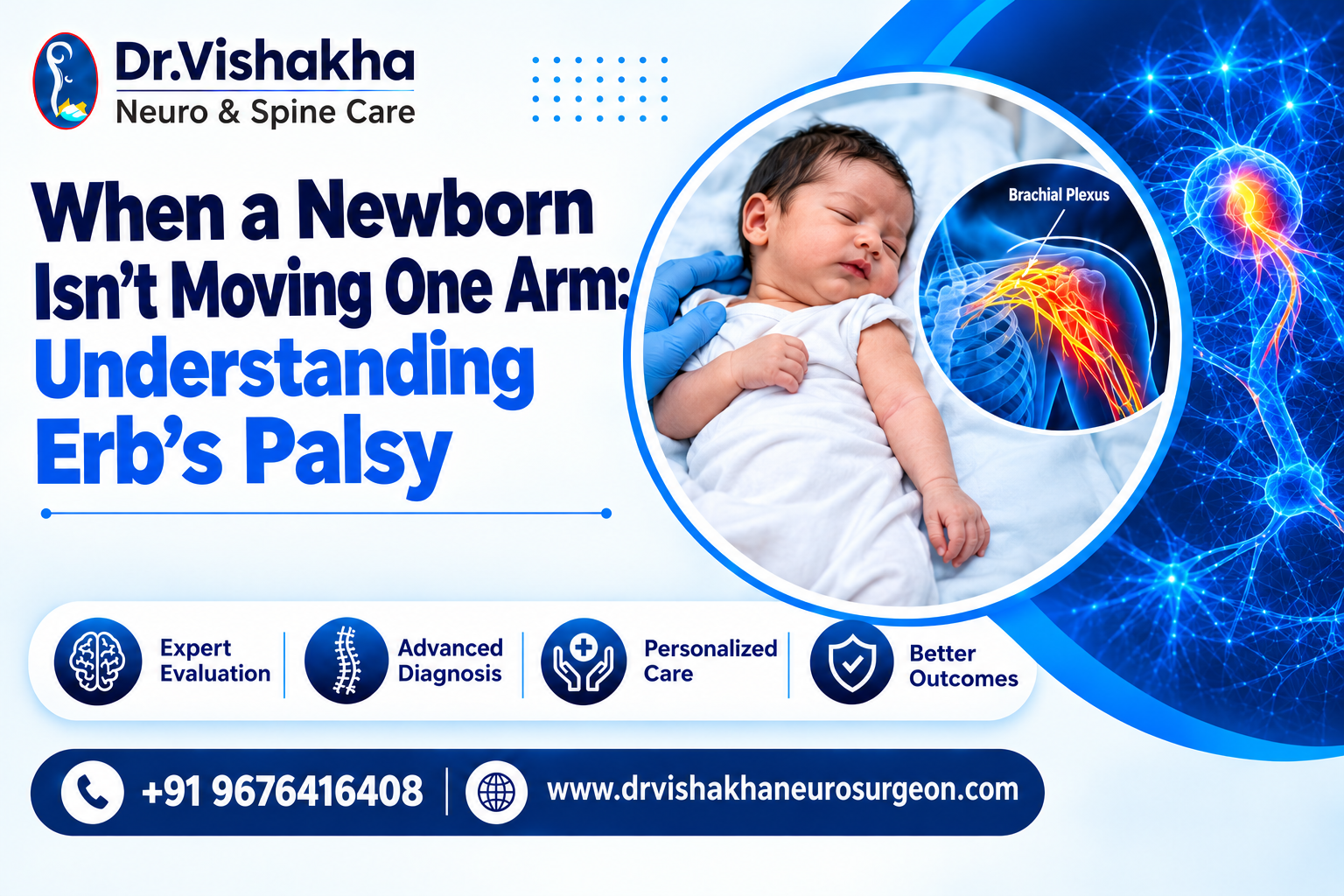
Noticing that a newborn is not moving one arm can be worrying for any parent. Often, the baby appears healthy in every other way, yet one arm stays limp by the side while the other moves freely.
In many cases, this is caused by a nerve injury that occurs during delivery. Known as Erb’s palsy, it is one of the more common birth-related nerve conditions, and most babies recover well with timely care.
This article explains Erb’s palsy in newborns in simple terms, what it is, why it happens, how it is diagnosed, and what treatment options are available.
Quick Answer Summary
Erb’s palsy in newborns is weakness in one arm caused by a stretch injury to the brachial plexus, the network of nerves that runs from the neck to the shoulder, arm, and hand. It usually occurs during a difficult delivery, most often when the baby’s shoulder gets stuck. Common signs include an arm held close to the body, an inward-turned hand, and a reduced reflex on one side. Most babies recover fully within the first few months with regular physiotherapy. A smaller number need nerve surgery, typically between 3 and 9 months of age. Early evaluation by a specialist is important for the best outcome.
Understanding the Condition (What Is Erb’s Palsy?)
The condition is named after Wilhelm Erb, a German neurologist who described this pattern of arm weakness in the 1870s. To understand why it affects babies the way it does, it helps to look at how the arm’s nerves are arranged.
How the Brachial Plexus Is Organised
Five nerve roots leave the spinal cord in the lower neck and upper back. They join, divide, and rejoin to form the brachial plexus, with each root contributing to different movements.
| Nerve root | Main function |
| C5 | Lifting and rotating the shoulder |
| C6 | Bending the elbow, turning the palm up |
| C7 | Straightening the elbow and wrist |
| C8 | Finger movement and grip |
| T1 | Fine hand movements |
Why the Upper Nerves Are Most Often Affected
When the baby’s head is pulled sideways during delivery, the upper roots (C5 and C6) are stretched first and most strongly. This is why a brachial plexus birth injury most commonly weakens the shoulder and elbow, while the hand often keeps working normally.
Why Recovery Takes Time
Injured nerves heal by regrowing slowly, at roughly 1 mm per day. Since the distance from the neck to the arm muscles is long, visible improvement can take weeks to months. This is why doctors track progress over time rather than judging the outcome in the first few days.
What It Does Not Affect
Erb’s palsy is an injury to the nerves outside the spinal cord. It does not affect the baby’s brain, intelligence, or overall development.
How Common Is Erb’s Palsy?
Erb’s palsy affects approximately 1 to 2 babies in every 1,000 births.
Fortunately, most cases are mild. The majority of babies regain good movement within weeks to a few months, often without the need for surgery.
| Fact | What it means |
| About 1–2 per 1,000 births | It is a recognised and well-studied condition |
| Most cases are mild stretch injuries | Nerves often heal on their own |
| Majority recover well within the first year | Consistent therapy supports recovery |
| A smaller group needs surgery | Regular specialist follow-up helps identify this early |
Types of Erb’s Palsy
Nerve injuries vary in severity, and the type of injury influences the treatment plan.
- Neurapraxia: The mildest form. The nerve is stretched but not torn. Recovery usually begins within a few weeks.
- Neuroma: Some nerve fibres are damaged, and scar tissue forms during healing. This can interfere with nerve signals, leading to partial recovery.
- Rupture: The nerve is torn, but not at the point where it joins the spinal cord. It does not heal on its own and usually requires surgery.
- Avulsion: The most severe type. The nerve root is pulled away from the spinal cord. Surgical treatment is needed to restore function using healthy nerves.
Injuries are also classified by the number of nerve roots involved:
| Type | Nerves involved | Areas affected |
| Classic Erb’s palsy | C5–C6 | Shoulder and elbow |
| Extended Erb’s palsy | C5–C7 | Shoulder, elbow, and wrist |
| Total plexus palsy | C5–T1 | Entire arm and hand |
Symptoms and Causes
Recognising Erbs Palsy Symptoms in Baby
Parents are often the first to notice that something is different. Common Erb’s palsy symptoms in baby include:
- The arm hangs loosely and stays close to the body
- The elbow remains straight and the hand turns inward
- A weak or absent startle (Moro) reflex on the affected side
- Normal finger movement, but limited shoulder movement
- Discomfort when the arm is moved, which may suggest an associated fracture
It is important to note that a baby not moving arm after birth does not always have a nerve injury. A fractured collarbone can look similar, which is why a thorough medical examination is necessary.
What Causes It?
The most common cause is shoulder dystocia, a situation where the baby’s shoulder becomes caught behind the mother’s pelvic bone during delivery. The traction needed to free the shoulder can overstretch the nerves.
Known risk factors include:
- High birth weight (macrosomia, usually above 4 kg)
- Diabetes during pregnancy
- Prolonged or difficult labour
- Breech delivery
- Use of forceps or vacuum during delivery
In many cases, the injury occurs despite appropriate care during delivery. It is rarely the result of anything the parents did or did not do.
Diagnosis and Tests
Diagnosis begins with a detailed physical examination. The doctor observes the baby’s movements, checks reflexes, and gently assesses each joint.
Additional tests may include:
| Test | Purpose |
| X-ray | To rule out a fracture of the collarbone or upper arm |
| Shoulder ultrasound | To assess the position and stability of the shoulder joint |
| Nerve conduction study / EMG | To measure how well signals pass through the nerves |
| MRI | To check for nerve root avulsion when surgery is being planned |
One key milestone is biceps recovery by around 3 months of age. If the baby can bend the elbow against gravity by this stage, the long-term outlook is generally very good. If not, the specialist may discuss surgical options.
What Happens Next?
Physiotherapy
For most babies, treatment begins with physiotherapy. A physiotherapist will teach parents specific Erb’s palsy exercises for infants that can be done gently at home several times a day.
These usually include:
- Raising the arm slowly forward and to the side
- Bending and straightening the elbow
- Turning the palm upward and downward
- Gentle outward rotation of the shoulder
- Encouraging reaching and tummy time to build strength
The treating team may advise resting the arm for the first week before starting exercises. Parents should avoid lifting the baby by the affected arm and should dress the affected arm first to reduce strain on healing nerves.
Consistency is important. Regular, gentle exercise helps keep the joints flexible while the nerves recover.
When Surgery Is Considered
If there is limited improvement by 3 to 6 months, nerve surgery may be recommended. Common procedures include:
- Nerve grafting: bridging the damaged section with a nerve taken from another part of the body
- Nerve transfer: redirecting a healthy nerve to power a weakened muscle
Some children may need muscle or tendon procedures later in childhood to improve shoulder or elbow function.
Erb’s Palsy Treatment in India
Access to Erb’s palsy treatment in India has improved significantly in recent years. Major cities now offer multidisciplinary teams that include paediatric neurosurgeons, plastic surgeons, and physiotherapists. Hyderabad has several well-equipped children’s hospitals with expertise in neonatal and nerve-related care.
Brachial Plexus Injury Treatment Cost in Hyderabad
The brachial plexus injury treatment cost in Hyderabad depends on the severity of the injury, the hospital chosen, and whether surgery is required.
| Treatment | Approximate range* |
| Specialist consultation | ₹800 – ₹2,000 |
| Physiotherapy session | ₹500 – ₹1,500 per session |
| Nerve conduction study / MRI | ₹3,000 – ₹15,000 |
| Nerve surgery (graft or transfer) | ₹2,00,000 – ₹5,00,000 |
*These figures are indicative only. Costs vary between hospitals, so it is advisable to request a written estimate and confirm insurance coverage in advance.
Questions to Ask Your Specialist
Preparing questions before the consultation can help families make informed decisions. Useful questions include:
- Which nerves are affected, and how severe is the injury?
- Is there a fracture that also needs treatment?
- Which exercises should we do, and how often?
- What signs of progress should we look for each month?
- At what stage would surgery be recommended?
- Which specialists will be involved in my baby’s care?
- What is the estimated cost, and what does insurance cover?
Frequently Asked Questions
- Can Erb’s palsy in newborns heal without surgery?
Yes. Many mild stretch injuries recover within weeks to a few months with regular physiotherapy. - What should I do if I notice my baby not moving arm after birth?
Inform your paediatrician as soon as possible. An early examination can rule out a fracture and ensure therapy begins at the right time. - When do Erb’s palsy symptoms in baby usually improve?
Many babies show noticeable improvement within the first 1 to 3 months. Elbow bending by 3 months is a positive indicator. - Are Erb’s palsy exercises for infants painful?
They should not be. The movements are slow and gentle. If the baby appears to be in pain, stop and consult your physiotherapist. - Can a brachial plexus birth injury be prevented?
Not always. Careful monitoring of high-risk pregnancies can reduce the risk, but some injuries occur despite appropriate care. - Will my child be able to lead a normal life?
Most children with Erb’s palsy grow up with good arm function and take part in everyday activities, including sports, especially when treatment begins early.
Conclusion
Erb’s palsy in newborns can be concerning for families, but the outlook for most babies is very positive. Many nerve injuries heal with time and regular physiotherapy, and effective surgical options are available for those who need them.
The most important step is early evaluation. A timely diagnosis, a clear treatment plan, and consistent follow-up give every baby the best chance of regaining strong, healthy arm movement.
Proficiency of Dr Vishakha – Neurosurgeries Expertise
Hydrocephalus (increased fluid in the brain): The procedure involves an endoscopic third ventriculostomy and CSF diversion (VP shunt) to treat complex hydrocephalus.
Craniosynostosis (abnormal head shape due to premature cranial suture fusion) surgeries: Helmet therapy is a technique that is used in both endoscopic and open surgery.
Spinal dysraphisms(Spina Bifida)– (spinal abnormalities present by birth) – surgical repair
Encephalocele repair surgery.
Vascular conditions and stroke surgeries: revascularisation surgeries for moyamoya disease.
Pediatric brain and spine tumour surgeries.
Pediatric brain and spine infection surgeries: Endoscopic and open surgeries for brain and spine infections.
Pediatric traumatic brain and spinal injury.
Antenatal counselling for congenital fatal neurosurgical conditions.
Related Links
Related treatment pages:
- Craniosynostosis: https://drvishakhaneurosurgeon.com/craniosynostosis/
- Pediatric Neurosurgery: https://drvishakhaneurosurgeon.com/pediatric-neurosurgery/
- Hydrocephalus: https://drvishakhaneurosurgeon.com/hydrocephalus/
- Antenatal Counselling: https://drvishakhaneurosurgeon.com/antenatal-counselling/
Other blog posts:
- Spina Bifida Journey: From Antenatal Diagnosis to Postnatal Repair: https://drvishakhaneurosurgeon.com/spina-bifida-journey-from-antenatal-diagnosis-to-postnatal-repair/
- Understanding Your Baby’s Milestones: How Brain & Spine Health Plays a Crucial Role: https://drvishakhaneurosurgeon.com/understanding-your-babys-milestones-how-brain-spine-health-plays-a-crucial-role-dr-vishakha/
- Is Your Baby’s Soft Spot Normal? Here’s How to Tell: https://drvishakhaneurosurgeon.com/is-your-babys-soft-spot-normal-heres-how-to-tell-dr-vishakha-explains/
Book a Consultation
If you have noticed reduced arm movement in your newborn, early expert assessment can make a meaningful difference. Consult Dr Vishakha Karpe, leading paediatric neurosurgeon in Hyderabad, for a detailed evaluation and personalised care plan.
📞 Call: +91 8618978597 | +91 9676416408
🌐 Visit: drvishakhaneurosurgeon.com
📅 Book an Appointment