Quick Answer Summary
Scoliosis in children is a sideways curvature of the spine, typically forming a “C” or “S” shape. It is most often identified between the ages of 10 and 15, during periods of rapid growth. Common signs include uneven shoulders, a prominent shoulder blade, an asymmetrical waistline, and a rib hump visible when the child bends forward. The forward-bend test (Adam’s test) is a quick, non-invasive screening method used by parents, schools and doctors. Most curves are mild and require only observation, while others may need bracing or surgery. Timely evaluation by a pediatric spine specialist helps prevent progression.
What Is Scoliosis?
The spine normally appears straight when viewed from behind. In scoliosis, it bends to one side and also rotates slightly. This rotation is what causes one side of the back or rib cage to appear more prominent.
The severity of the curve is measured using the Cobb angle on an X-ray. A curvature of 10 degrees or more is classified as scoliosis.
The encouraging news is that most cases of scoliosis in children are mild. Many children need only periodic review, with no active treatment.
What Are the Signs of Scoliosis in Children?
Scoliosis usually develops gradually and without pain. This makes visual observation especially important.
The most common signs of scoliosis in children include:
- One shoulder positioned higher than the other
- One shoulder blade more prominent than the other
- An uneven waistline or one hip appearing higher
- The head not centred directly above the pelvis
- Clothing that hangs unevenly on the body
- A visible rib hump when bending forward
Because pain is rarely present, these physical changes are often the only early indicators.
What Causes Scoliosis in Kids?
In most cases, no specific cause is found. This is known as idiopathic scoliosis and accounts for approximately 80% of cases. A family history increases the likelihood.
Less common causes include:
- Congenital abnormalities: vertebrae that form incompletely or unevenly before birth
- Neuromuscular conditions: such as cerebral palsy, muscular dystrophy or spina bifida
- Spinal cord abnormalities: including tethered cord, syringomyelia and Chiari malformation
- Tumours or infections of the spine, which are rare
It is worth clarifying that poor posture and heavy school bags do not cause scoliosis. They may lead to muscle strain, but they do not produce a structural curve.
Types of Scoliosis in Kids
Each type of curved spine in children follows a different course, and treatment is tailored accordingly.
| Type | Typical Age | Key Characteristics |
| Infantile idiopathic | 0–3 years | Some curves resolve naturally; others require close monitoring |
| Juvenile idiopathic | 4–9 years | Higher risk of progression due to remaining growth |
| Adolescent idiopathic | 10–18 years | Most common type; progression is more frequent in girls |
| Congenital | Present at birth | Caused by malformed vertebrae; may be associated with kidney or heart anomalies |
| Neuromuscular | Any age | Linked to nerve or muscle disorders; curves may progress rapidly |
| Syndromic | Any age | Associated with conditions such as Marfan syndrome or neurofibromatosis |
Signs Parents Often Notice at Home
Children rarely report changes in their spine themselves. Parents typically notice early indicators during routine activities:
- Bathing or swimming, when the back is easily visible
- Reviewing photographs, which may reveal a consistent tilt
- Clothing fittings, where measurements appear uneven
- Sports or dance practice, when coaches observe asymmetry
- Growth spurts, when changes in body shape become more noticeable
Important: Persistent back pain, pain at night, leg numbness or weakness, or bladder difficulties are not typical scoliosis symptoms in children. These may indicate an underlying spinal cord or nerve condition and require prompt medical evaluation.
How Is Scoliosis Screened and Diagnosed?
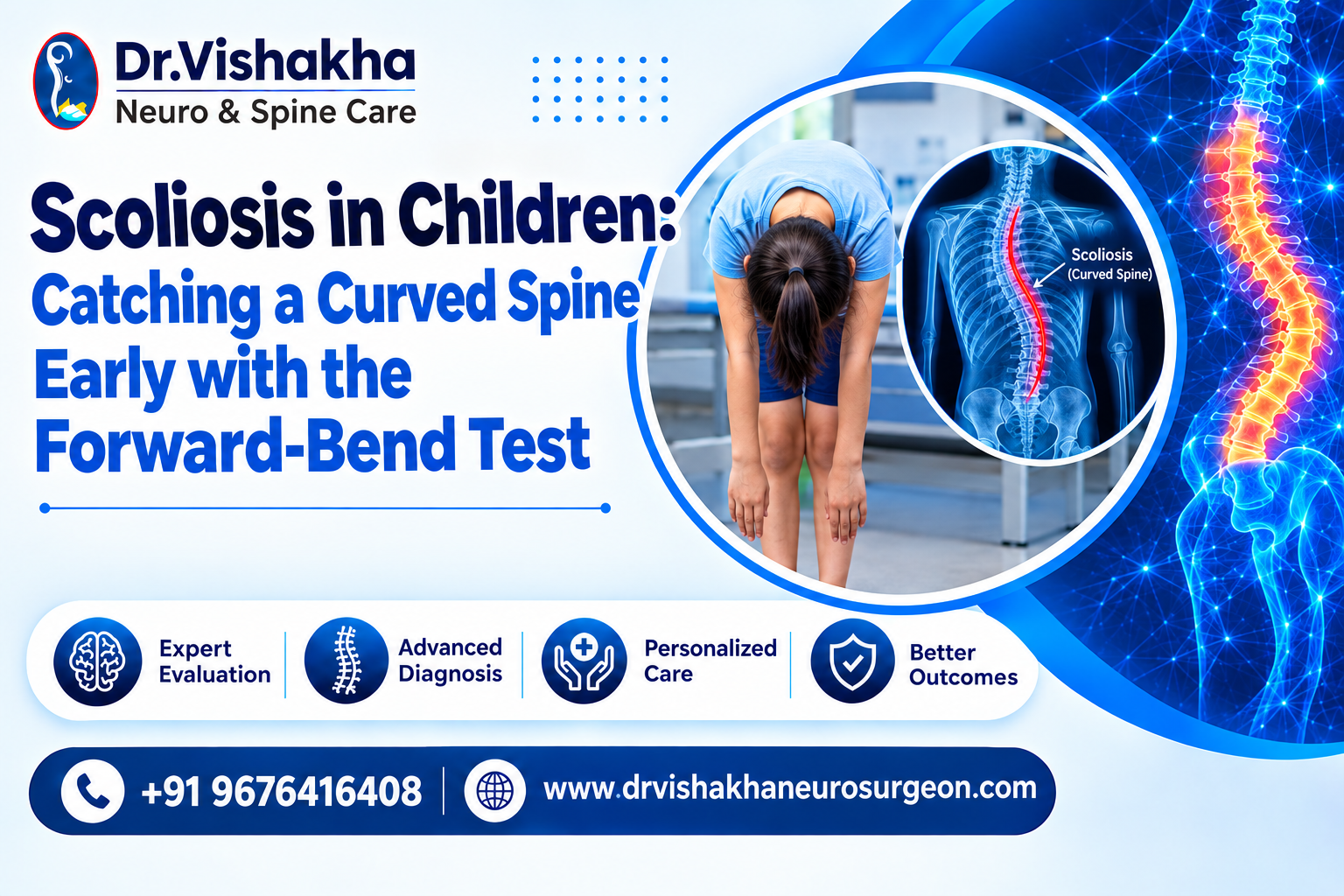
The Forward-Bend Test (Adam’s Test)
This simple screening test can be performed at home in under two minutes.
- The child stands with feet together, wearing a vest or no shirt.
- The child bends forward at the waist with arms hanging freely and palms together.
- The observer views the back from behind, at eye level.
- Any elevation of the ribs or lower back on one side is noted.
A visible hump suggests spinal rotation, a characteristic feature of scoliosis spine curvature in kids.
Clinical Evaluation
- Scoliometer measurement: quantifies the degree of trunk rotation
- Standing spine X-ray: confirms the curve and measures the Cobb angle
- Neurological examination: assesses reflexes, muscle strength and sensation
- MRI scan: advised when red flags are present, such as early onset, an atypical curve pattern, rapid progression, pain, neurological signs, or skin markers over the spine (a tuft of hair, dimple or birthmark)
The forward-bend test is a screening tool only. An X-ray is required to confirm and measure child spine curvature accurately.
Conditions We Often See
In certain cases, spinal curvature is associated with an underlying neurological condition. These require evaluation by a pediatric neurosurgeon:
- Spinal dysraphism (spina bifida): congenital defects of the spine and spinal cord
- Tethered spinal cord: abnormal attachment of the cord, causing stretching during growth
- Syringomyelia: a fluid-filled cavity within the spinal cord
- Chiari malformation: downward displacement of part of the brain, often linked with syringomyelia
- Spinal tumours and infections: uncommon, but important to exclude
Treating the underlying neurological cause early can help stabilize the curve and, in some cases, improve it.
What Happens Next?
Management depends on the size of the curve, the child’s remaining growth and the underlying cause.
| Curve Size | Recommended Approach |
| Below 20–25° | Observation with X-rays every 4–6 months |
| 25–40° in a growing child | Bracing, worn for prescribed hours daily |
| Above 45–50° | Surgical correction may be considered |
| Any curve with a neurological cause | Treatment of the underlying condition first |
Physiotherapy and core-strengthening exercises can support posture and overall wellbeing. These complement medical treatment rather than replace it.
Most children with scoliosis continue to participate fully in school, sports and everyday activities.
Questions to Ask Your Specialist
Preparing questions in advance helps make the consultation more productive:
- What is the Cobb angle of my child’s curve?
- What type of scoliosis has been diagnosed?
- Is there any indication of a spinal cord or nerve problem? Is an MRI required?
- What is the likelihood of progression during growth?
- Will a brace be needed, and for how many hours a day?
- Are there any activities my child should avoid?
- How often should follow-up visits be scheduled?
Frequently Asked Questions
- At what age does scoliosis usually appear?
Scoliosis can develop at any age. It is most commonly identified between 10 and 15 years, during the growth spurt around puberty. - Can scoliosis correct itself?
Some infantile curves resolve without treatment. Adolescent curves generally do not disappear, but many remain mild and stable. - How reliable is the forward-bend test?
It is a dependable screening method. However, a positive result must be confirmed with an X-ray to measure the curve. - Is scoliosis painful for children?
Typically, no. Persistent or night-time pain should be evaluated, as it may indicate another underlying condition. - Can heavy school bags cause scoliosis?
No. Heavy bags may cause muscle strain, but they do not cause a structural sideways curve. - When should a pediatric neurosurgeon be consulted?
A consultation is advisable if the curve appears early in life, progresses rapidly, is accompanied by pain, leg weakness or bladder problems, or if there are skin changes over the lower spine. - How often should children be screened?
Routine screening at regular check-ups is recommended, particularly between 10 and 14 years. Children with a family history should be monitored more closely.
Conclusion
Early detection is the most effective tool in managing scoliosis in children. A brief forward-bend test, performed a few times a year, can identify a curve while the spine is still developing and treatment options are most effective.
Observation is simple, and a timely consultation offers clarity. If you notice any asymmetry in your child’s back, a specialist evaluation is the recommended next step. Understanding scoliosis in children early allows families to make informed, confident decisions about care.
Proficiency of Dr Vishakha – Neurosurgeries Expertise
Hydrocephalus (increased fluid in the brain): The procedure involves an endoscopic third ventriculostomy and CSF diversion (VP shunt) to treat complex hydrocephalus.
Craniosynostosis (abnormal head shape due to premature cranial suture fusion) surgeries: Helmet therapy is a technique that is used in both endoscopic and open surgery.
Spinal dysraphisms(Spina Bifida)– (spinal abnormalities present by birth) – surgical repair
Encephalocele repair surgery.
Vascular conditions and stroke surgeries: revascularisation surgeries for moyamoya disease.
Pediatric brain and spine tumour surgeries.
Pediatric brain and spine infection surgeries: Endoscopic and open surgeries for brain and spine infections.
Pediatric traumatic brain and spinal injury.
Antenatal counselling for congenital fatal neurosurgical conditions.
Related Links
Related treatment pages:
- Craniosynostosis: https://drvishakhaneurosurgeon.com/craniosynostosis/
- Pediatric Neurosurgery: https://drvishakhaneurosurgeon.com/pediatric-neurosurgery/
- Hydrocephalus: https://drvishakhaneurosurgeon.com/hydrocephalus/
- Antenatal Counselling: https://drvishakhaneurosurgeon.com/antenatal-counselling/
Other blog posts:
- Spina Bifida Journey: From Antenatal Diagnosis to Postnatal Repair: https://drvishakhaneurosurgeon.com/spina-bifida-journey-from-antenatal-diagnosis-to-postnatal-repair/
- Understanding Your Baby’s Milestones: How Brain & Spine Health Plays a Crucial Role: https://drvishakhaneurosurgeon.com/understanding-your-babys-milestones-how-brain-spine-health-plays-a-crucial-role-dr-vishakha/
- Is Your Baby’s Soft Spot Normal? Here’s How to Tell: https://drvishakhaneurosurgeon.com/is-your-babys-soft-spot-normal-heres-how-to-tell-dr-vishakha-explains/
Book a Consultation
If you have noticed uneven shoulders, a tilted waist or a rib hump, an early assessment can provide clarity and peace of mind.
Consult Dr Vishakha Karpe, recognised by families as the best child scoliosis specialist Hyderabad trusts for complex pediatric spine conditions.
📞 Call: +91 8618978597 | +91 9676416408
🌐 Visit: https://drvishakhaneurosurgeon.com
🏥 Rainbow Children’s Hospital: Banjara Hills & Hydernagar, Hyderabad
Schedule your child’s spine evaluation today.