
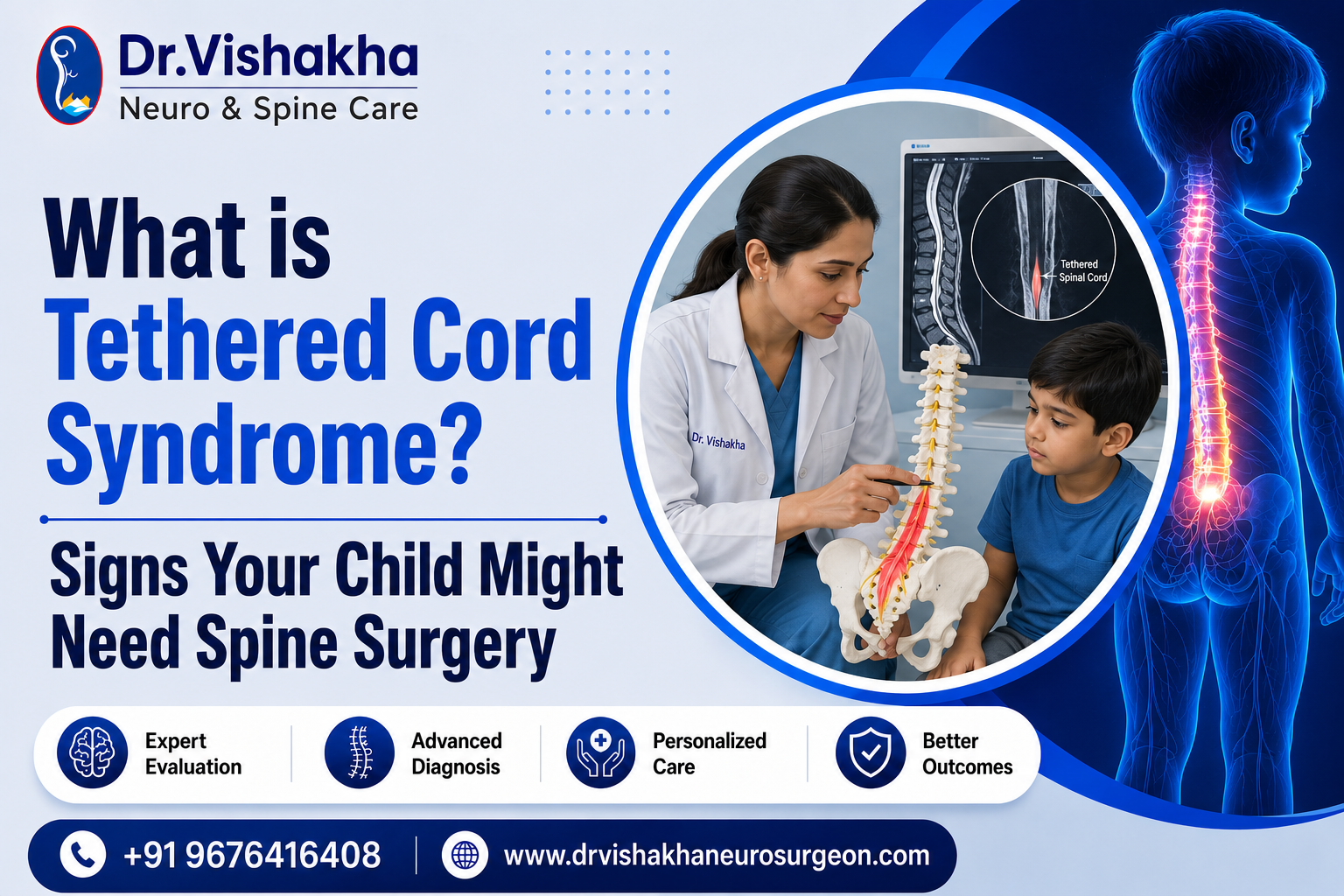
Parents often notice small, seemingly unconnected details in their child’s development: reluctance to run and play, unexplained leg weakness, or a small skin indentation and patch of hair near the base of the spine, identified by a paediatrician during a routine check-up. Individually, these signs can seem minor and easy to overlook. Together, however, they can point to a condition known as tethered cord syndrome, one of the more commonly missed causes of movement and bladder problems in children.
This article explains what the condition is, why it develops, and how parents can recognise the early warning signs before they progress into something harder to treat.
Understanding Tethered Cord Syndrome
Tethered cord syndrome occurs when the spinal cord becomes abnormally attached to nearby tissue, restricting its normal movement as a child grows. This tension can damage nerves over time, leading to back pain, leg weakness, foot deformities, or bladder and bowel problems. Tethered cord symptoms often develop gradually, which is why the condition is sometimes missed in its early stages. Diagnosis typically involves an MRI, and treatment usually means a surgical procedure called detethering. When caught early, most children recover well and avoid long-term nerve damage, which is why understanding the early signs matters so much.
Under normal circumstances, the spinal cord sits loosely inside the spinal canal, free to shift slightly as the body grows and moves. In pediatric tethered cord syndrome, however, the cord becomes fixed or anchored to surrounding tissue at its lower end. As the child grows taller, the spinal cord is stretched, placing mechanical strain on nerve tissue that was never designed to bear that kind of tension. Over time, this tension can interfere with normal nerve function.
Causes and Types of Tethered Cord Syndrome
Tethered cord syndrome is generally grouped into two broad types, based on when and why the tethering develops:
- Primary (congenital) tethered cord syndrome — present from birth, caused by a structural abnormality that formed during early spinal development
- Secondary (acquired) tethered cord syndrome — develops later in childhood, most often when scar tissue forms after a previous spinal surgery, such as spina bifida repair
Within these two types, several underlying structural issues can cause the spinal cord to become tethered:
- Tight filum terminale — a thickened or inelastic strand at the base of the spinal cord
- Spinal lipoma — a fatty growth attached to the spinal cord
- Split cord malformation (diastematomyelia) — the spinal cord splits into two strands, sometimes separated by bone or cartilage
- Dermal sinus tract — a small channel connecting the skin to the spinal canal, which can also increase infection risk
- Prior spina bifida repair — scar tissue from earlier surgery can occasionally cause the cord to re-tether later in childhood
Some children are born with these structural differences, while others develop tethering as a delayed effect of previous spinal surgery.
Why Early Diagnosis Is Important in Children
A child’s spine grows quickly, particularly during infancy and again during later growth spurts. Each phase of growth adds further tension to an already-tethered cord. The earlier a diagnosis is made, the smaller the window of nerve exposure to that tension, and the better the long-term outcome tends to be.
Left unrecognised, the condition rarely remains static. It tends to progress gradually, often revealing itself through a change in gait or a new bladder symptom that eventually prompts medical attention.
Early Signs and Symptoms of Tethered Cord Syndrome in Children
Recognising the signs of tethered cord syndrome can be difficult, largely because symptoms often develop slowly and can be mistaken for growing pains or general clumsiness. Common indicators include:
| Category | What to Watch For |
| Skin markers | Skin dimple, hairy patch, fatty lump, or birthmark on the lower back |
| Movement | Leg weakness, unusual gait, difficulty running or climbing stairs |
| Skeletal changes | Foot deformities, uneven leg length, worsening scoliosis |
| Bladder and bowel | New-onset bedwetting, urinary urgency, or constipation |
| Pain | Back pain, especially worsened by bending or activity |
Not every child shows all of these signs. Sometimes, only one persistent, easy-to-dismiss clue is present, which is exactly why paediatricians recommend evaluating any unusual skin marking on a newborn’s lower back.
Diagnosis of Tethered Cord Syndrome
Tethered cord diagnosis generally begins with a physical examination, including a close look at the lower spine and a neurological assessment of leg strength, reflexes, and bladder function. If tethering is suspected, an MRI of the spine is the standard imaging test, as it clearly shows the position of the spinal cord and any structures anchoring it in place. In infants younger than about six months, an ultrasound can sometimes be used instead, since the spinal bones have not yet fully hardened.
When Does Tethered Cord Syndrome Require Spine Surgery?
Not every child with a tethered spinal cord needs immediate surgery. Pediatric spine surgery typically becomes necessary when:
- Symptoms are present and progressing, such as worsening weakness or new bladder issues
- Imaging confirms a structural cause likely to continue causing tension as the child grows
- A child previously underwent spina bifida repair and is now showing signs of re-tethering
For children with no symptoms and only an incidental finding on a scan, doctors sometimes recommend close monitoring rather than immediate surgery. This decision is made on a case-by-case basis.
What Happens If Tethered Cord Syndrome Is Left Untreated?
This is the aspect that concerns specialists most. Nerve damage caused by chronic tension tends to be progressive and, in advanced stages, irreversible. Without treatment, a child may experience:
- Permanent leg weakness or muscle wasting
- Worsening foot or spinal deformities
- Long-term bladder or bowel dysfunction
- Chronic back pain persisting into adulthood
The condition rarely resolves on its own. Once nerve tissue has been damaged by prolonged stretching, restoring full function becomes considerably more difficult, which is why timing plays such a critical role in outcomes.
What Happens Next: Treatment
When surgery is recommended, the procedure is known as tethered cord release surgery, or detethering. The surgeon carefully identifies the structure anchoring the spinal cord, whether a tight filum, lipoma, or scar tissue, and releases it, allowing the cord to move freely again within the spinal canal.
The typical treatment path includes:
- Confirmatory imaging to map the exact tethering point
- Surgical detethering, performed under general anaesthesia with careful nerve monitoring throughout
- Post-operative observation to assess movement, sensation, and bladder function
- Follow-up imaging and check-ups over the following months to confirm stability
Recovery After Spine Surgery in Children
Most children spend a few days in hospital following surgery, with movement gradually resuming as swelling settles. General recovery expectations include:
- Gentle physiotherapy may begin once the surgical site has healed sufficiently
- Bladder and bowel function are monitored closely, as these can take longer to normalise than motor strength
- Symptoms present before surgery, such as pain, often improve significantly; symptoms caused by permanent nerve damage may only partially resolve
- Regular follow-up visits track growth and help rule out re-tethering over time
Most children regain considerable strength and mobility within a few weeks, particularly when surgery is performed before significant nerve damage has occurred.
Can Tethered Cord Syndrome Be Prevented?
There is no guaranteed way to prevent the condition, particularly when it arises from a congenital spinal difference present at birth. What can make a meaningful difference is early detection. Newborn physical examinations that identify unusual skin markings on the lower back, followed by prompt imaging where indicated, give families the best possible starting point for early intervention.
When to Consult a Specialist
Parents should consult a paediatric neurosurgeon if their child shows any combination of the following:
- A visible mark, skin dimple, or lump on the lower back has been present since birth
- New or worsening leg weakness, limping, or difficulty using stairs
- Sudden bedwetting after previously being toilet-trained
- Unexplained, persistent back pain
- A history of spina bifida repair accompanied by new symptoms
Questions to Ask Your Specialist
- Is my child’s tethered cord causing active symptoms, or is it an incidental finding?
- What are the risks of surgery compared with continued monitoring?
- How experienced is the surgical team with spine surgery for children?
- Which symptoms are likely to improve after surgery, and which may not?
- How often will follow-up scans be required?
- What signs of re-tethering should we watch for as our child grows?
FAQs
- What is tethered cord syndrome in simple terms?
It is a condition in which the spinal cord is abnormally attached to nearby tissue, causing it to stretch and sustain damage as a child grows.
- What are the earliest signs of tethered cord symptoms in babies?
A skin dimple, hairy patch, or fatty lump on the lower back at birth is often the earliest visible clue, sometimes appearing well before any movement or bladder symptoms.
- Is tethered cord surgery safe for children?
Yes. When performed by an experienced paediatric neurosurgeon, detethering surgery is generally safe and often prevents further nerve damage.
- Can tethered cord syndrome return after surgery?
In some cases, particularly following previous spina bifida repair, re-tethering can occur later in childhood, which is why regular follow-up is important.
- Does every child with a tethered cord need surgery?
No. Children without symptoms may simply be monitored, while those with active or progressive symptoms are usually advised to undergo surgery.
- How long does recovery take after tethered cord release surgery?
Hospital stays are typically a few days, with most children returning to regular activity within a few weeks, though full nerve recovery can take longer.
Proficiency of Dr Vishakha – Neurosurgeries Expertise
Hydrocephalus (increased fluid in the brain): The procedure involves an endoscopic third ventriculostomy and CSF diversion (VP shunt) to treat complex hydrocephalus.
Craniosynostosis (abnormal head shape due to premature cranial suture fusion) surgeries: Helmet therapy is a technique that is used in both endoscopic and open surgery.
Spinal dysraphisms(Spina Bifida)– (spinal abnormalities present by birth) – surgical repair
Encephalocele repair surgery.
Vascular conditions and stroke surgeries: revascularisation surgeries for moyamoya disease.
Pediatric brain and spine tumour surgeries.
Pediatric brain and spine infection surgeries: Endoscopic and open surgeries for brain and spine infections.
Pediatric traumatic brain and spinal injury.
Antenatal counselling for congenital fatal neurosurgical conditions.
Conclusion
Tethered cord syndrome can be easy to miss, particularly when its signs emerge gradually over months or years rather than all at once. Recognising the pattern, whether a skin marking at birth, a change in gait, or an unexpected bladder issue, can make a significant difference to a child’s long-term mobility and comfort. With timely diagnosis and appropriate surgical care, most children go on to lead full, active lives.
Related Links
Related treatment pages:
- Spina Bifida: https://drvishakhaneurosurgeon.com/spina-bifida/
- Craniosynostosis: https://drvishakhaneurosurgeon.com/craniosynostosis/
- Hydrocephalus: https://drvishakhaneurosurgeon.com/hydrocephalus/
- Brain and Spine Tumours: https://drvishakhaneurosurgeon.com/brain-and-spine-tumors/
Other blog posts:
- Paediatric Neurosurgery in Hyderabad: What Conditions Are Treated?: https://drvishakhaneurosurgeon.com/paediatric-neurosurgery-in-hyderabad-what-conditions-are-treated/
- Brain or Spine Issues Spotted on Your Anomaly Scan? Please Take a Moment to Read This: https://drvishakhaneurosurgeon.com/brain-or-spine-issues-spotted-on-your-anomaly-scan-please-take-a-moment-to-read-this/
- Spine Health from Childhood Onwards – Preventing Problems Before They Occur: https://drvishakhaneurosurgeon.com/spine-health-from-childhood-onwards-preventing-problems-before-they-occur/
Book a Consultation
If your child shows any signs of tethered cord syndrome, do not wait for symptoms to worsen. Book a consultation with Dr Vishakha, the best paediatric neurosurgeon in Hyderabad, today.
📞 Call: +91 8618978597 or +91 9676416408 🌐 Visit: drvishakhaneurosurgeon.com