
Many parents notice, somewhere around the third or fourth month, that their baby’s head does not look quite even. There may be a flat patch on one side. The forehead may look wider on the left than the right. One ear may sit a little further forward than the other.
If this sounds familiar, you are far from alone. A change in head shape is one of the most common reasons babies are brought to a children’s brain and spine specialist.
The good news is that in most babies, this is a simple pressure problem that improves with a few changes at home. In a small number of babies, it is caused by a problem in the skull bones and needs surgery. These two conditions can look very similar in the early months, which is why they are so often confused.
This article explains what each condition is, what causes it, how doctors tell them apart, and what treatment involves.
Quick Answer Summary
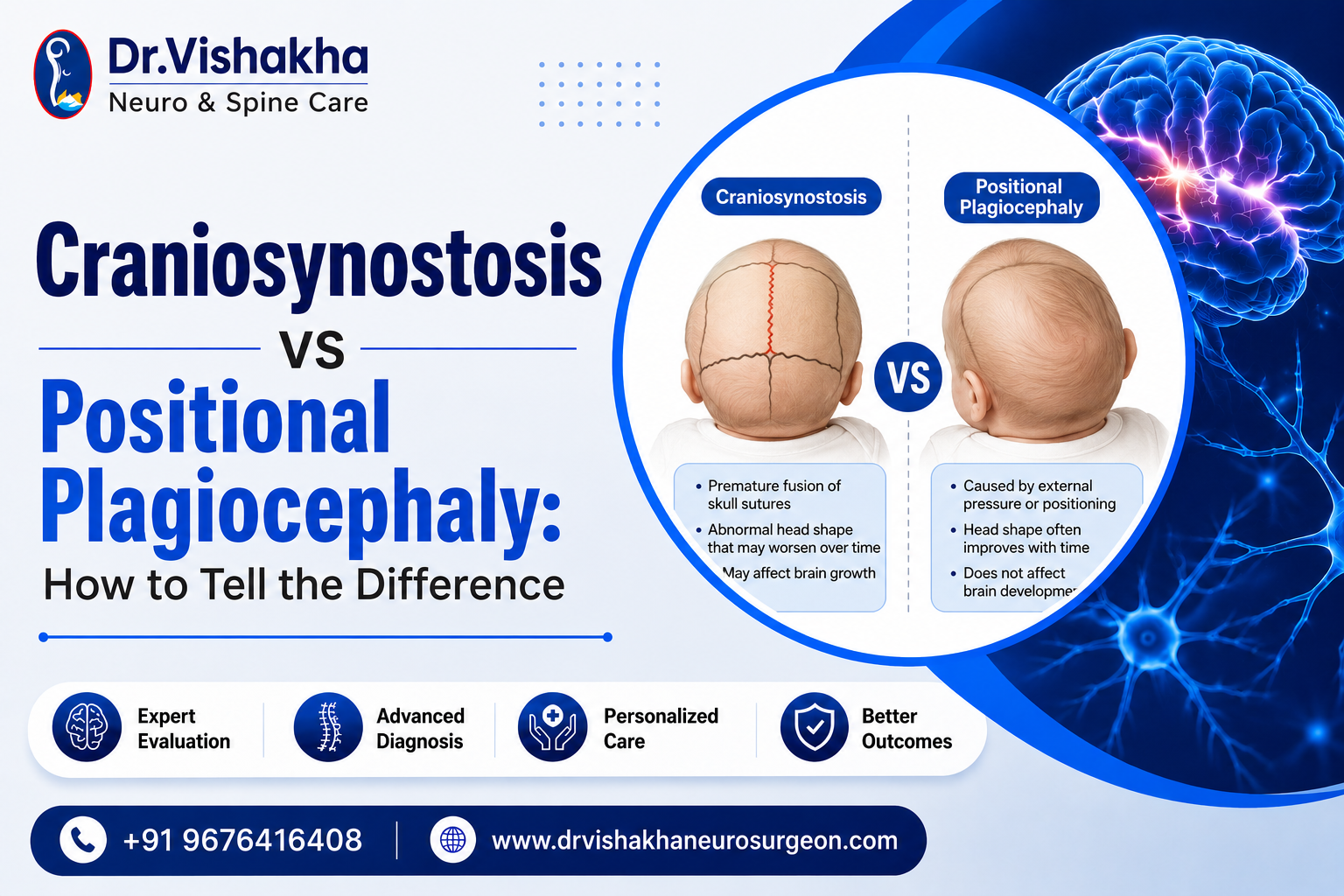
Both conditions cause an abnormal head shape, but the reason behind each is different. Positional plagiocephaly is flattening caused by pressure from outside, usually because a baby lies in the same position for long periods. The skull bones themselves are normal. Craniosynostosis happens when the joints between the skull bones close too early, so the head cannot grow evenly. The main difference between craniosynostosis and plagiocephaly is this: plagiocephaly is a shaping problem that gets better with position changes, while craniosynostosis is a bone problem that usually needs an operation.
What Are Craniosynostosis and Plagiocephaly?
A baby’s skull is not one solid piece of bone. It is made of several bone plates joined together by soft, flexible joints called sutures. There is also a soft spot on top of the head, called the fontanelle. These joints stay open in early life so the head can grow quickly as the brain grows.
Positional plagiocephaly happens when a baby’s soft skull rests against a firm surface for many hours a day. A mattress, a car seat or a rocker will slowly flatten the area that takes the pressure. Looking down from above, the head appears slightly slanted, with the ear and forehead on the flat side pushed forward.
Craniosynostosis is different. Here, one or more of the joints between the skull bones close earlier than they should. The brain keeps growing, but it cannot push outward where the joint has sealed. So the head grows in the directions that are still open. This may give a long, narrow head, a raised or flat forehead, or a face that looks uneven. This abnormal shape of the skull comes from the bone itself, not from outside pressure, and it does not correct on its own.
Causes: Why Do These Happen?
Positional plagiocephaly usually has simple, everyday reasons:
- Sleeping on the back. This is still the safest sleep position and should be continued.
- Long hours in car seats, prams, bouncers and swings.
- A tight neck muscle, called torticollis, which makes the baby always turn to one side.
- Being born early, as premature babies have softer skull bones.
- Twins or triplets, where space in the womb is tight.
- Very little tummy time while the baby is awake.
The causes of craniosynostosis are not related to how a baby is handled or cared for. In most children, it happens by chance, with no family history at all. In a smaller number of cases, it is linked to a change in the genes, a thyroid problem in the mother during pregnancy, or certain medicines taken in pregnancy. It affects about one in every 2,000 to 2,500 babies.
This point matters for parents: an irregular head shape caused by early closing of the skull joints is not anyone’s fault.
Plagiocephaly vs Craniosynostosis: A Simple Comparison
It helps to first know the main types of Craniosynostosis. Each one is named after the joint that has closed:
- Sagittal – the head becomes long and narrow. This is the most common type.
- Coronal – one side of the forehead becomes flat, and that eye may look wider or higher.
- Metopic – the forehead becomes narrow and triangular, with a ridge down the middle.
- Lambdoid – the rarest type. It causes flattening at the back of the head and looks very much like plagiocephaly.
| What to look at | Positional Plagiocephaly | Craniosynostosis |
| Cause | Pressure from outside | Skull joints closing too early |
| Head seen from above | Slanted, like a tilted box | Long, narrow, or uneven front to back |
| Ear on the flat side | Pushed forward | Pulled backwards and slightly down |
| Ridge along the joint | Not present | Often a firm ridge you can feel |
| Soft spot | Open and normal | May close early or feel tight |
| Over time | Gets better with position changes | Stays the same or becomes clearer |
| Main treatment | Position changes, physiotherapy, helmet | Surgery |
Diagnosing and Treating Plagiocephaly
Most babies do not need any scan. The doctor looks at the head from above, gently feels the skull joints, checks how freely the neck turns, and measures the head. That examination is usually enough.
The treatment of positional plagiocephaly starts with simple steps:
- Change the position. Turn the head to the other side at each sleep, switch sides while feeding, and move the cot so your baby naturally looks the other way.
- Give tummy time. Short sessions, several times a day, while the baby is awake and you are watching.
- Physiotherapy. This is important if the neck is tight. Loosening the neck muscle often solves the flattening at its source.
- Helmet therapy. A light, custom-made helmet, usually offered between four and eight months for moderate or severe flattening. It does not squeeze the head. It simply leaves space for the head to grow where it needs to.
Most families see a clear change within a few months. The earlier the treatment of positional plagiocephaly begins, the shorter and easier it usually is.
How to Tell the Difference Between Craniosynostosis and Plagiocephaly
At home, the difference between craniosynostosis and plagiocephaly often shows up in three simple ways.
Does the shape improve? Flattening from pressure gets better once you change positions and add tummy time. Craniosynostosis does not respond to this. It often becomes more noticeable as the baby grows.
What can you feel? Run your fingers gently over your baby’s head. A firm ridge along a joint line is one of the clearest Signs of craniosynostosis. In plagiocephaly, the head feels smooth.
Where are the ears? In plagiocephaly, the ear on the flat side sits forward. In lambdoid craniosynostosis, it sits further back and lower.
Other signs of craniosynostosis include a soft spot that closes very early, a head size that stops increasing on the growth chart, poor feeding, constant fussiness, or eyes that look uneven.
It is fair to say that mild craniosynostosis symptoms can be hard to spot. A slightly raised forehead. A faint ridge. A small unevenness that shows in photos but is easy to miss in person. Many parents watch these mild craniosynostosis symptoms for months before asking. A short check-up settles the question quickly and is always worth doing.
Conditions We Often See
A few situations come up again and again in the clinic.
Sagittal type is the most common. The right sagittal craniosynostosis treatment depends mainly on age. Babies under six months can often have keyhole (endoscopic) surgery through two small cuts, followed by a few months of helmet therapy. Older babies usually need open surgery, where the surgeon reshapes and repositions the skull bones in one operation. Modern sagittal craniosynostosis treatment is safe in experienced hands and gives very good long-term results.
There is also a group known as syndromes with craniosynostosis. In these children, the early closing of skull joints comes along with other features. Apert, Crouzon, Pfeiffer, Muenke and Saethre-Chotzen are the ones seen most often. Children with syndromes with craniosynostosis may also have a flatter middle part of the face, joined fingers or toes, hearing problems or breathing difficulty. They do best with a team that includes brain surgery, plastic surgery, eye care, ENT and genetics.
We also see babies with flattening along with a tight neck, plagiocephaly in premature twins, and children referred for a suspected abnormal head shape that turns out to be a normal family trait.
What Happens Next?
If craniosynostosis is confirmed, a low-dose CT scan shows exactly which joint has closed and helps plan the surgery. The operation is best done within the first year, because the fast-growing brain does much of the reshaping once the skull is released.
Waiting too long carries real risk. The Complications of craniosynostosis include rising pressure inside the head, which can affect eyesight, cause ongoing headaches, or slow down learning and development. The Complications of craniosynostosis also include a face that stays uneven and the confidence issues an uncorrected irregular head shape can bring during school years.
The outlook today is genuinely good. Most children go home within a week, meet their milestones as expected, and grow up with no restrictions. Knowing which of the types of Craniosynostosis is present, and treating it at the right age, is what decides the result. Even the less common causes of craniosynostosis, including genetic ones, can be managed well with a clear plan and regular follow-up.
Questions to Ask Your Specialist
Writing your questions down before the visit helps you get more out of it.
- Is this flattening from pressure, or is a skull joint involved?
- Do we need a scan, and can radiation be kept to a minimum?
- If it is from pressure, what exactly should we change at home?
- Is a helmet right for my child, and when should it start?
- If surgery is needed, would keyhole or open surgery suit my baby better, and why?
- What is recovery like, and how many days in hospital?
- Will we need follow-up scans or a second operation later?
- Should we consider genetic testing?
Frequently Asked Questions
- Can a flat head correct itself without treatment?
Mild flattening often improves once a baby starts sitting and rolling and spends less time lying down. Moderate and severe cases need active position changes, physiotherapy or a helmet.
- Is a helmet uncomfortable for a baby?
No. It is light, made to fit your child, and does not press on the head. Most babies get used to it within a few days and sleep and play normally.
- At what age should craniosynostosis surgery be done?
Keyhole surgery works best before six months. Open surgery is usually done between six and twelve months. Your surgeon will advise based on which joint is involved and how your baby is growing.
- Does an abnormal shape of the skull always mean a problem with the brain?
No. Positional plagiocephaly does not affect the brain. Even in craniosynostosis, surgery done at the right time usually prevents any lasting effect on development.
- How is the difference between craniosynostosis and plagiocephaly confirmed?
Usually by examination alone, based on head shape, ear position, skull ridges and how things change over time. A scan is done only when surgery is being planned.
- Can craniosynostosis come back after surgery?
It is uncommon when only one joint is involved. Children with syndrome-related types are followed more closely and may occasionally need a second operation as they grow.
- Is it passed down in families?
Most cases happen by chance. A small number, mainly the syndrome-related types, have a genetic cause, which is why some families are offered counselling.
Conclusion
The main point is simple. A flat spot on a baby’s head is common and usually corrects itself with the right steps at home. A skull joint that closes too early is uncommon and needs surgery at the right age. The difference between craniosynostosis and plagiocephaly can usually be settled by an experienced children’s neurosurgeon in one unhurried visit, often without any scan at all.
You watch your child more closely than anyone else. If the shape of your baby’s head keeps worrying you, that is reason enough to have it checked. Early answers are almost always simpler answers.
Proficiency of Dr Vishakha – Neurosurgeries Expertise
Hydrocephalus (increased fluid in the brain): The procedure involves an endoscopic third ventriculostomy and CSF diversion (VP shunt) to treat complex hydrocephalus.
Craniosynostosis (abnormal head shape due to premature cranial suture fusion) surgeries: Helmet therapy is a technique that is used in both endoscopic and open surgery.
Spinal dysraphisms(Spina Bifida)– (spinal abnormalities present by birth) – surgical repair
Encephalocele repair surgery.
Vascular conditions and stroke surgeries: revascularisation surgeries for moyamoya disease.
Pediatric brain and spine tumour surgeries.
Pediatric brain and spine infection surgeries: Endoscopic and open surgeries for brain and spine infections.
Pediatric traumatic brain and spinal injury.
Antenatal counselling for congenital fatal neurosurgical conditions.
Related Links
Related treatment pages:
- Craniosynostosis: https://drvishakhaneurosurgeon.com/craniosynostosis/
- Pediatric Neurosurgery: https://drvishakhaneurosurgeon.com/pediatric-neurosurgery/
- Hydrocephalus: https://drvishakhaneurosurgeon.com/hydrocephalus/
- Antenatal Counselling: https://drvishakhaneurosurgeon.com/antenatal-counselling/
Other blog posts:
- Spina Bifida Journey: From Antenatal Diagnosis to Postnatal Repair: https://drvishakhaneurosurgeon.com/spina-bifida-journey-from-antenatal-diagnosis-to-postnatal-repair/
- Understanding Your Baby’s Milestones: How Brain & Spine Health Plays a Crucial Role: https://drvishakhaneurosurgeon.com/understanding-your-babys-milestones-how-brain-spine-health-plays-a-crucial-role-dr-vishakha/
- Is Your Baby’s Soft Spot Normal? Here’s How to Tell: https://drvishakhaneurosurgeon.com/is-your-babys-soft-spot-normal-heres-how-to-tell-dr-vishakha-explains/
Book a Consultation
If your child’s head shape is worrying you, an early check-up brings clarity.
Phone: +91 8618978597 | +91 9676416408 Website: https://drvishakhaneurosurgeon.com
Book an appointment with Dr Vishakha, one of the leading paediatric neurosurgeons in Hyderabad.