
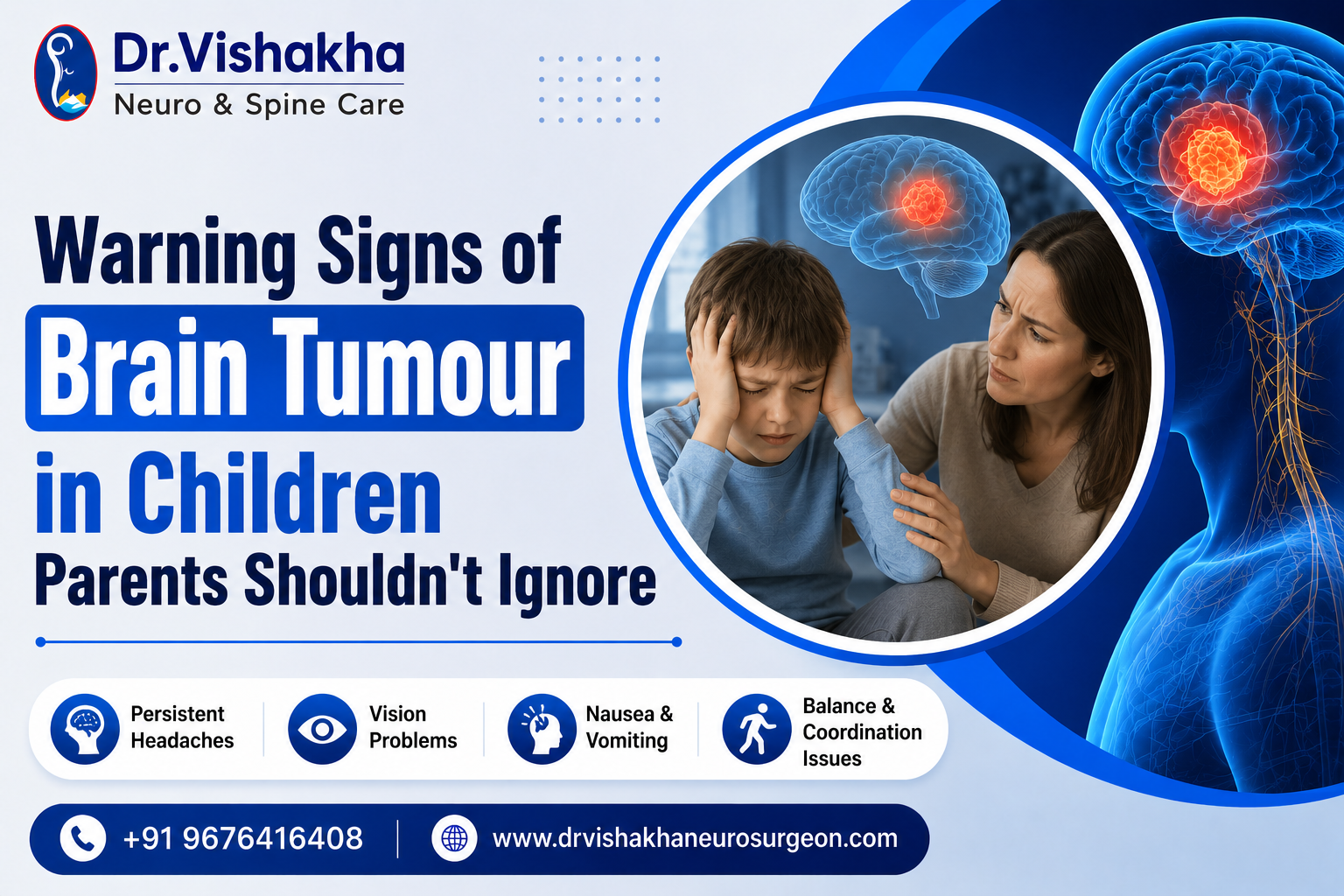
The most important brain tumour warning signs in children are early morning headaches with vomiting, a squint or blurred vision, sudden clumsiness or unsteady walking, seizures, and a rapidly growing head size in babies. Many of these look like ordinary childhood complaints at first, which is exactly why they get missed. If your child has a headache pattern that worsens over weeks, vomits soon after waking, or loses a skill they had already mastered, see a paediatric neurosurgeon quickly. A simple MRI can settle the question. Early detection often means safer surgery, gentler treatment, and a far better recovery.
Understanding the Condition
Brain tumours are the most common solid tumours seen in children. Even so, they are often found late. This is not because parents are careless. It happens because the early signs look exactly like everyday childhood problems.
Here is why the symptoms behave the way they do. The skull is a hard, closed box. It cannot stretch. So when something starts growing inside, pressure in the head goes up. When a child lies flat all night, that pressure builds up even more. This is why the headache and vomiting are worse just after waking up. Once the child sits up and starts moving, some of the pressure drains away, and the child seems fine again by mid-morning.
That “sick in the morning, normal by noon” pattern is one of the clearest early symptoms of brain tumour growth in children. It is also the one most families explain away.
A pediatric brain tumour is not the same as an adult one. In children, these tumours often grow in the back and lower part of the brain, the area that controls balance, eye movement and the flow of fluid around the brain. That is why parents usually notice wobbly walking, a squint or repeated vomiting rather than anything dramatic.
One point needs to be very clear. Most headaches in children are harmless. What needs checking is not one symptom on its own, but a group of symptoms that keeps coming back and keeps getting worse.
What Brain Tumour Signs Should Parents Never Ignore?
These are the brain tumour warning signs that should lead to a doctor’s visit rather than more waiting:
- Headache in the morning with vomiting, especially when there is no fever or loose motions, and the child feels better after vomiting.
- Headaches that keep getting worse over weeks, wake the child from sleep, or increase coughing, bending or straining.
- Eye problems — a new squint, double vision, drooping eyelid, or a child suddenly sitting very close to the television.
- Poor balance — leaning to one side, falling often, dropping things, bumping into doors.
- A first-time fit or seizure in a child who never had one before.
- Losing a skill the child already had — messy handwriting, unclear speech, or a toilet-trained toddler wetting again.
- A baby’s head growing too fast, with a bulging soft spot and eyes that look downward.
- Behaviour change — sleeping too much, unusual irritability, or a sharp drop in concentration.
- Growth or hormone changes — height not increasing, puberty starting too early, or drinking and passing urine excessively.
- The head always tilted to one side, often mistaken for a neck problem.
One sign alone usually means nothing serious. Two or three together, getting worse week by week, need a check-up.
Types of Brain Tumours Seen in Children
The common brain tumours in childhood are different from those in adults. Several of them respond very well to surgery.
| Tumour Type | Where It Grows | What Parents Usually Notice |
| Medulloblastoma | Back of the brain | Morning vomiting, unsteady walking, head tilt |
| Pilocytic astrocytoma | Back of the brain or near the eye nerves | Slow-building headache, poor vision, clumsiness |
| Ependymoma | Fluid channels of the brain | Pressure symptoms, stiff neck, irritability |
| Craniopharyngioma | Near the hormone gland | Poor growth, vision loss, excessive thirst |
| Brainstem glioma | Brainstem | Squint, facial weakness, difficulty swallowing |
| Germ cell tumour | Centre of the brain | Early puberty, trouble looking upward |
Pilocytic astrocytoma is a good example of why early testing matters. It grows slowly and can often be completely cured with surgery.
How Can Brain Tumour Symptoms Vary by Age?
A baby cannot say “my head hurts”. So the body shows it in other ways. The types of brain tumour symptoms change a lot depending on the child’s age.
| Age Group | What It Usually Looks Like |
| Babies (0–2 years) | Head size increasing fast, tight soft spot, poor feeding, constant crying, eyes looking downward, delayed milestones |
| Toddlers (2–5 years) | Frequent falls, unsteady walking, vomiting without reason, head tilt, losing speech or toilet training |
| School age (6–12 years) | Morning headaches, squint, poor handwriting, falling marks, behaviour change, seizures |
| Teenagers (13–18 years) | Long-lasting headaches, blurred or double vision, mood swings, tiredness, hormone problems, poor balance |
A teenager’s irritability gets blamed on hormones. A toddler’s falling gets blamed on age. Every stage of childhood offers an easy excuse, which is why the same types of brain tumour symptoms go unchecked for months.
Conditions We Often See
Not every worrying symptom turns out to be a tumour. Children who come with these complaints are often found to have:
- Hydrocephalus — extra fluid inside the brain causing very similar pressure symptoms
- Craniosynostosis — skull bones joining too early, changing the head shape
- Spina bifida and tethered cord — spinal problems present from birth
- Brain and spine infections — which can look like tumours on a scan
- Epilepsy caused by a small, harmless spot in the brain
- Moyamoya disease and stroke in children
- Migraine, weak eyesight or low haemoglobin — the most common answer of all
The check-up aims to rule out serious problems, not to confirm your fear.
What Happens Next?
The testing process is far simpler than most parents expect.
Step 1 – Talking to the doctor. Your description matters more than any machine. When did it start? At what time of day? What has changed? Parents notice things no test can pick up.
Step 2 – Physical examination. The doctor checks reflexes, walking, eye movements, head size, and looks inside the eye to see if pressure is raised.
Step 3 – The scan. An MRI of the brain. It is painless and uses no radiation. Small children may be given mild sedation so they stay still.
Step 4 – The treatment plan. If a pediatric brain tumor is found, neurosurgeons, cancer specialists and radiologists plan the treatment together. Surgery can often remove the tumour completely. Sometimes a small keyhole procedure is done first to release pressure. Modern methods such as navigation systems and nerve monitoring during surgery allow smaller cuts, shorter hospital stays and quicker recovery.
Step 5 – Recovery. Physiotherapy, vision support and a slow, planned return to school.
Frequently Asked Questions
- Do headaches in children usually mean a brain tumour?
No. Most are caused by migraine, weak eyesight, less water intake or sinus problems. Worry only when headaches keep worsening, disturb sleep, or come with morning vomiting. - What is the first thing a parent may notice at home?
The early symptoms of brain tumor growth are usually small behaviour changes — extra tiredness, poor appetite, weak concentration, a new head tilt, or bumping into things. Any clear change from your child’s normal self is worth checking. - Can brain tumours in children be cured?
Many can. Harmless tumours like pilocytic astrocytoma are often fully cured with surgery. Even cancerous ones have much better survival rates today, especially when found early. - Which test confirms it?
An MRI scan of the brain with contrast is the best test. A CT scan is used only in emergencies when speed matters. - Do these tumours run in families?
Usually not. Only a small number are linked to genetic conditions. Nothing you did or did not do caused this. - When should I stop waiting and get a scan done?
If symptoms last more than two weeks and are getting worse instead of better. Spotting brain tumor warning signs early is the one thing fully in a parent’s hands. - Will surgery leave my child disabled?
Most children recover very well. The outcome depends mainly on the size and location of the tumour, which is why early treatment matters so much.
Conclusion
Brain tumours in children are usually found late not because there were no signs, but because the signs looked ordinary. Headache, vomiting, poor focus and clumsiness happen in healthy children too, and each has many harmless explanations.
The difference lies in the direction things are moving. Ordinary problems settle down. Serious ones follow a fixed time pattern, take away skills the child already had, and get worse week after week.
You do not need to worry about every headache. You only need to know which patterns are unusual. Recognising brain tumor warning signs early gives doctors more options and gives your child a much smoother recovery.
In most cases, the check-up will bring relief. In the few cases where it does not, the time you saved will make all the difference.
Proficiency of Dr Vishakha – Neurosurgeries Expertise
Hydrocephalus (increased fluid in the brain): The procedure involves an endoscopic third ventriculostomy and CSF diversion (VP shunt) to treat complex hydrocephalus.
Craniosynostosis (abnormal head shape due to premature cranial suture fusion) surgeries: Helmet therapy is a technique that is used in both endoscopic and open surgery.
Spinal dysraphisms(Spina Bifida)– (spinal abnormalities present by birth) – surgical repair
Encephalocele repair surgery.
Vascular conditions and stroke surgeries: revascularisation surgeries for moyamoya disease.
Pediatric brain and spine tumour surgeries.
Pediatric brain and spine infection surgeries: Endoscopic and open surgeries for brain and spine infections.
Pediatric traumatic brain and spinal injury.
Antenatal counselling for congenital fatal neurosurgical conditions.
Related Links
Related treatment pages:
- Craniosynostosis: https://drvishakhaneurosurgeon.com/craniosynostosis/
- Pediatric Neurosurgery: https://drvishakhaneurosurgeon.com/pediatric-neurosurgery/
- Hydrocephalus: https://drvishakhaneurosurgeon.com/hydrocephalus/
- Antenatal Counselling: https://drvishakhaneurosurgeon.com/antenatal-counselling/
Other blog posts:
- Spina Bifida Journey: From Antenatal Diagnosis to Postnatal Repair: https://drvishakhaneurosurgeon.com/spina-bifida-journey-from-antenatal-diagnosis-to-postnatal-repair/
- Understanding Your Baby’s Milestones: How Brain & Spine Health Plays a Crucial Role: https://drvishakhaneurosurgeon.com/understanding-your-babys-milestones-how-brain-spine-health-plays-a-crucial-role-dr-vishakha/
- Is Your Baby’s Soft Spot Normal? Here’s How to Tell: https://drvishakhaneurosurgeon.com/is-your-babys-soft-spot-normal-heres-how-to-tell-dr-vishakha-explains/
Book a Consultation
If a symptom in your child has lasted longer than it should, get it checked by one of India’s leading paediatric neurosurgeons.
📞 +91 8618978597 | +91 9676416408
🌐 Book Your Appointment
📍 Eureka Neuro and Spine Clinic, Madeenaguda, Hyderabad, Telangana 500050
One consultation is enough to replace worry with a clear plan.