
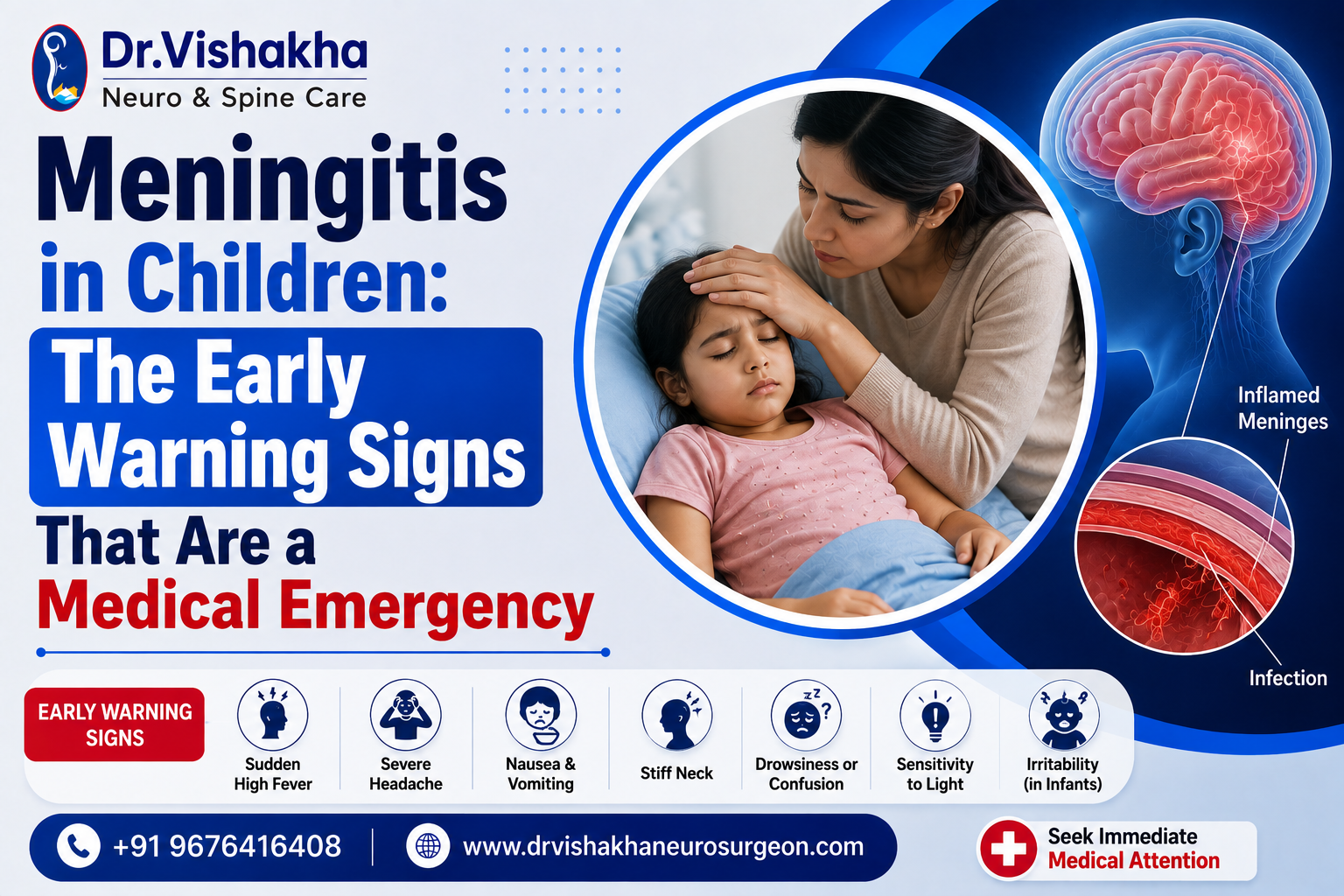
The early signs and symptoms of meningitis in children include high fever with a stiff neck, severe headache, vomiting, dislike of bright light, extreme drowsiness, and a rash that does not fade when pressed. In babies, watch for a bulging soft spot, refusal to feed, a high-pitched cry and floppy limbs. This illness can worsen within hours, not days. If your child looks unusually unwell and is getting worse fast, go to the emergency room immediately. Do not wait overnight. Early antibiotics save lives and prevent lasting damage to hearing, vision and the brain.
What Is Meningitis, and What Makes It So Dangerous?
The brain and spinal cord are covered by three thin protective layers known as the meninges. These layers cushion and shield the most delicate organs in the body. Meningitis occurs when these layers become inflamed, usually because an infection has reached them.
The danger lies in the anatomy. The skull is a rigid, closed structure that cannot expand. When the meninges swell, the pressure inside the head rises and begins to press on the brain itself. This is what produces the severe headache, the vomiting and the drowsiness that characterise the illness.
Speed is the second concern. A child may appear reasonably well in the evening and become critically ill by the following morning. Most childhood infections allow time for observation. This one does not.
The third difficulty is that the initial hours closely resemble ordinary flu — fever, tiredness, headache and vomiting. Nothing at that stage suggests an emergency. This overlap explains why treatment is often delayed, and why familiarity with the early signs and symptoms of meningitis is so important for parents.
There is an important reassurance. When treatment begins early, the majority of children recover completely. The outcome depends almost entirely on how quickly the child reaches a hospital.
Common Causes of Meningitis in Children
The causes of meningitis fall into a few clear groups, and they do not all behave the same way.
Viral meningitis is the most frequent type. It is usually milder, often follows a common viral infection, and many children recover with rest, fluids and supportive care.
Bacterial meningitis is the dangerous one. It is far less common, but it moves fast and can be fatal within a day if untreated. This is the type that needs immediate hospital admission and intravenous antibiotics.
Tuberculous meningitis develops more slowly, over weeks. It is still seen in India and often presents with weight loss, prolonged low fever and gradual behaviour change.
Fungal meningitis is rare and usually affects children with weakened immunity.
The germs most often responsible in children include pneumococcus, meningococcus, Haemophilus influenzae type b, group B streptococcus in newborns, and tuberculosis bacteria.
Certain children carry a higher risk:
- Newborns and infants under one year
- Children who missed routine vaccinations
- Those with a shunt or previous brain or spine surgery
- Children with head injury or skull fracture
- Children with untreated ear or sinus infections
- Those with low immunity or a chronic illness
- Children in crowded settings such as hostels and daycare
Vaccines have made a real difference here. The Hib, pneumococcal and meningococcal vaccines have dramatically cut cases of bacterial meningitis worldwide. Keeping the immunisation schedule up to date is genuine protection, not just paperwork.
Symptoms of Meningitis
Symptoms differ sharply depending on your child’s age, so read the section that fits.
In babies under one year
Babies cannot tell you what hurts, so their bodies do the talking:
- Soft spot on the head that looks bulging or tight
- Refusing feeds or vomiting repeatedly
- A shrill, unusual, high-pitched cry
- Floppy, limp body or unusually stiff movements
- Very sleepy and hard to wake
- Cold hands and feet with a hot body
- Fever, or in newborns, an abnormally low temperature
- Irritability that worsens when picked up or cuddled
That last one is worth remembering. Most sick babies calm down when held. A baby with meningitis often cries harder, because movement hurts.
In older children
- High fever with chills
- Severe headache that keeps intensifying
- Stiff neck, or pain when bending the chin to the chest
- Repeated vomiting without diarrhoea
- Discomfort in bright light
- Confusion, unusual talk or difficulty staying awake
- Seizures or fits
- A purple or red rash that stays visible when pressed with a glass
- Joint or muscle pain, refusal to walk
When to Rush to the Hospital
| Warning Sign | Why It Matters |
| Non-fading rash | Suggests infection has entered the bloodstream |
| Seizure with fever in an older child | Possible brain involvement |
| Very hard to wake | Rising pressure inside the head |
| Neck too stiff to bend | Classic sign of meningeal irritation |
| Bulging soft spot in a baby | Pressure building in the skull |
| Rapid worsening over hours | The defining feature of this illness |
Not every child shows all of these. Some show only two or three. Recognising the early signs and symptoms of meningitis is less about ticking every box and more about noticing that your child is deteriorating unusually fast.
Diagnosis and Treatment
Emergency evaluation follows a structured sequence.
Clinical examination. The doctor assesses temperature, neck stiffness, level of alertness, the soft spot in infants, and examines the eyes for signs of raised pressure.
Blood tests. These confirm the presence of infection and help identify the organism involved.
Lumbar puncture. A fine needle is used to collect a small sample of spinal fluid from the lower back. Although parents often find this test worrying, it is the only reliable method of identifying the causative organism and selecting the correct antibiotic. It is performed under local anaesthesia and takes only a few minutes.
Imaging. A CT or MRI scan may be performed first if the child is very drowsy or has had seizures, to check for complications such as fluid accumulation or an abscess.
Treatment. Intravenous antibiotics are started immediately, often before test results are available, since delay significantly worsens outcomes. Steroids help reduce inflammation. Fluids, fever control and anti-seizure medication provide support through the acute phase. Viral cases are managed with supportive treatment alone.
Surgical intervention. This becomes necessary when complications develop, such as hydrocephalus requiring a shunt, or a brain abscess requiring drainage. In these situations, a paediatric neurosurgeon joins the treating team.
Conditions We Often See
Fever with headache does not always indicate meningitis. Children presenting with similar complaints are frequently diagnosed with:
- Hydrocephalus — excess fluid in the brain, sometimes a complication of infection
- Brain abscess or tuberculoma — collections of infection needing surgical drainage
- Encephalitis — inflammation of brain tissue itself
- Febrile seizures — common in toddlers and usually harmless
- Severe migraine with vomiting and light sensitivity
- Sinus or ear infection spreading toward the brain
- Simple viral fever — thankfully, the most common answer of all
Assessment exists to rule out the dangerous possibilities quickly, not to confirm your worst fear.
What Happens Next?
When bacterial infection is confirmed, admission for one to two weeks of intravenous antibiotics is standard. Most children begin showing improvement within two to three days.
Recovery continues after discharge. A hearing assessment is essential, as hearing loss is the most common long-term complication. Vision and developmental reviews follow. Some children require physiotherapy or speech therapy for a period.
Family members may be prescribed preventive antibiotics if the meningococcal type is identified. Any pending vaccinations are usually completed before discharge.
Follow-up generally continues for six to twelve months. The majority of children return to school and normal activity without lasting difficulty.
Questions to Ask Your Specialist
- Which type of infection does my child have — viral, bacterial or tuberculous?
- How long will the antibiotic course last?
- Are there any complications on the scan?
- Will hearing or vision be affected?
- Does anyone else at home need preventive medicine?
- Which vaccines are still pending?
- What follow-up tests will be needed after discharge?
Frequently Asked Questions
- How quickly can meningitis become serious?
Within hours. A child can appear mildly unwell in the morning and be critically ill by night. This speed is what separates it from ordinary fever. - Is every case life-threatening?
No. Viral cases are usually mild and settle with supportive care. Bacterial meningitis disease is the type that demands emergency treatment. - Can it be prevented?
Largely, yes. Vaccination against Hib, pneumococcus and meningococcus offers strong protection. Good hand hygiene and treating ear infections promptly also help. - Is a stiff neck always present?
No, and this trips up many families. Babies and very young children often show no neck stiffness at all. Spotting the early signs and symptoms of meningitis in infants means watching the soft spot, the feeding and the cry instead. - Is a lumbar puncture safe for children?
Yes. It is a routine, well-established test done under local anaesthesia. Serious complications are rare, and the information it gives is essential. - Does it spread from child to child?
Some bacterial and viral types spread through coughing, sneezing and close contact. Household members may be given preventive antibiotics in certain cases. - Will my child fully recover?
Most do, especially when treatment starts early. Delay is the single biggest factor behind lasting problems such as hearing loss or seizures.
Conclusion
Meningitis is one of the few childhood illnesses where timing changes the outcome more than anything else. Delay of even a few hours can affect recovery, while early treatment allows most children to return to full health with no lasting effects.
Parents do not need to memorise medical details. What matters is recognising one pattern: a child whose condition is worsening by the hour rather than by the day needs emergency assessment the same night. Fever with a stiff neck. Fever with a rash that does not fade under pressure. A baby refusing feeds who cannot be settled despite comforting.
No family has ever regretted going to an emergency department and being reassured that it was a viral fever. The regret, when it occurs, comes from waiting until morning.
If your child seems different from any illness you have seen before, seek medical attention immediately.
Proficiency of Dr Vishakha – Neurosurgeries Expertise
Hydrocephalus (increased fluid in the brain): The procedure involves an endoscopic third ventriculostomy and CSF diversion (VP shunt) to treat complex hydrocephalus.
Craniosynostosis (abnormal head shape due to premature cranial suture fusion) surgeries: Helmet therapy is a technique that is used in both endoscopic and open surgery.
Spinal dysraphisms(Spina Bifida)– (spinal abnormalities present by birth) – surgical repair
Encephalocele repair surgery.
Vascular conditions and stroke surgeries: revascularisation surgeries for moyamoya disease.
Pediatric brain and spine tumour surgeries.
Pediatric brain and spine infection surgeries: Endoscopic and open surgeries for brain and spine infections.
Pediatric traumatic brain and spinal injury.
Antenatal counselling for congenital fatal neurosurgical conditions.
Related Links
Related treatment pages:
- Craniosynostosis: https://drvishakhaneurosurgeon.com/craniosynostosis/
- Pediatric Neurosurgery: https://drvishakhaneurosurgeon.com/pediatric-neurosurgery/
- Hydrocephalus: https://drvishakhaneurosurgeon.com/hydrocephalus/
- Antenatal Counselling: https://drvishakhaneurosurgeon.com/antenatal-counselling/
Other blog posts:
- Spina Bifida Journey: From Antenatal Diagnosis to Postnatal Repair: https://drvishakhaneurosurgeon.com/spina-bifida-journey-from-antenatal-diagnosis-to-postnatal-repair/
- Understanding Your Baby’s Milestones: How Brain & Spine Health Plays a Crucial Role: https://drvishakhaneurosurgeon.com/understanding-your-babys-milestones-how-brain-spine-health-plays-a-crucial-role-dr-vishakha/
- Is Your Baby’s Soft Spot Normal? Here’s How to Tell: https://drvishakhaneurosurgeon.com/is-your-babys-soft-spot-normal-heres-how-to-tell-dr-vishakha-explains/
Book a Consultation
If your child is showing worrying symptoms, or you need expert follow-up after a brain or spine infection, speak to one of India’s leading paediatric neurosurgeons.
📞 +91 8618978597 | +91 9676416408
🌐 Book Your Appointment
📍 Eureka Neuro and Spine Clinic, Madeenaguda, Hyderabad, Telangana 500050
In an emergency, go to the nearest hospital first. Expert follow-up can come after.