Introduction to Pediatric Moyamoya Disease
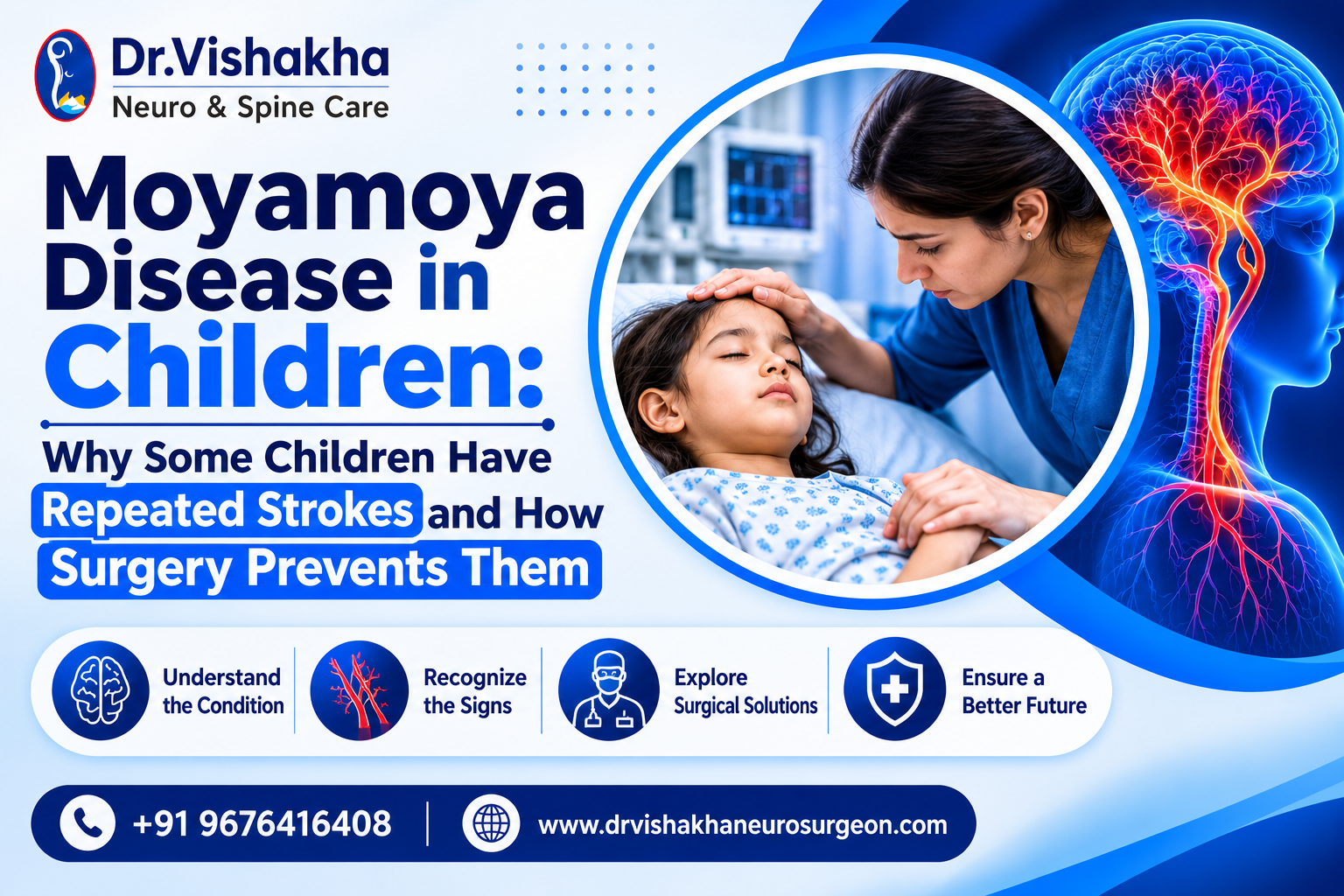
Stroke is often regarded as a condition of older adults, yet it can also occur in children. Moyamoya disease in children is one of the recognised causes of childhood stroke and is notable for its tendency to cause repeated events when left untreated.
The early signs are frequently brief and may be mistaken for fainting, fatigue or migraine. A child may develop sudden weakness of a hand or slurred speech after crying or blowing out birthday candles, and then recover completely within minutes. Such episodes warrant careful medical evaluation.
With timely diagnosis and appropriate surgical treatment, blood flow to the brain can be restored and the risk of future strokes substantially reduced.
What Is Pediatric Moyamoya Disease?
Moyamoya disease is a rare, progressive condition in which the major arteries at the base of the brain gradually narrow and may eventually become blocked. These arteries normally supply a large part of the brain with blood.
In response to this narrowing, the brain develops a network of small collateral blood vessels around the blockage. In angiography, this network has a hazy appearance, which gave the condition its name; “moyamoya” is a Japanese term meaning “puff of smoke”.
These collateral vessels are fragile and cannot supply sufficient blood flow on their own. When the same pattern of narrowing occurs in association with another medical condition, it is termed moyamoya syndrome. The two are managed in a similar way.
Causes and Risk Factors
The exact cause of moyamoya disease has not been fully established. It is not linked to parental actions during pregnancy or early childhood.
Recognised risk factors include:
- Genetic factors: variants in the RNF213 gene have been associated with moyamoya, particularly in people of East Asian descent
- Family history: a small proportion of children have an affected parent or sibling
- Associated conditions: Down syndrome, neurofibromatosis type 1 (NF1) and sickle cell disease
- Prior cranial radiation for the treatment of another illness
- Sex: the condition is slightly more common in girls
Signs and Symptoms in Children
Moyamoya disease symptoms in children commonly present as transient ischaemic attacks (TIAs). These are brief episodes of reduced blood flow that resolve within minutes to hours. Because recovery is often complete, these episodes are frequently overlooked.
| Symptom | Clinical presentation |
| Hemiparesis | Sudden weakness of one arm, leg or side of the body |
| Speech disturbance | Slurred speech or difficulty finding words |
| Sensory changes | Numbness or tingling of the face or limbs |
| Headache | Recurrent headaches, sometimes resembling migraine |
| Seizures | Focal or generalised seizures |
| Involuntary movements | Abnormal jerking or twisting movements of the limbs |
| Cognitive changes | Declining school performance or developmental delay |
Symptoms are characteristically triggered by situations that cause rapid breathing or reduced fluid levels, including:
- crying or intense emotional distress
- forceful blowing, such as into balloons, candles or wind instruments
- vigorous physical exertion
- fever or dehydration
Recurrent episodes associated with these triggers should always be reported to a doctor.
How Moyamoya Disease Affects the Brain
Rapid breathing lowers the level of carbon dioxide in the blood, which causes the blood vessels of the brain to constrict. In a healthy child, this has no significant effect. In a child with moyamoya, whose cerebral blood supply is already limited, this constriction can reduce blood flow below the level required for normal brain function.
This mechanism explains why recurrent stroke in children with moyamoya is the principal clinical concern. The arterial narrowing typically progresses over time, and each episode of reduced blood flow carries a risk of permanent brain injury. Repeated strokes can affect movement, speech, learning and behaviour.
In children, moyamoya most commonly causes ischaemic strokes, which result from inadequate blood flow. In adults, haemorrhagic strokes, caused by rupture of the fragile collateral vessels, are more frequent.
Diagnosis of Pediatric Moyamoya Disease
Evaluation begins with a detailed clinical history and a thorough neurological examination. An accurate description of each episode, including its triggers and duration, is particularly valuable.
| Investigation | Purpose |
| MRI of the brain | Identifies areas affected by previous strokes |
| MR angiography (MRA) | Demonstrates narrowing of the major cerebral arteries |
| Cerebral angiography (DSA) | Provides detailed images of the blood vessels; the gold standard for diagnosis and surgical planning |
| Perfusion studies (SPECT or perfusion MRI) | Assesses which regions of the brain have reduced blood flow |
| Blood investigations | Identifies associated conditions, such as sickle cell disease |
Treatment Options for Pediatric Moyamoya Disease
The aim of Moyamoya disease treatment is to protect the brain and prevent further strokes. Medical therapy cannot reverse arterial narrowing, but it plays a supportive role:
- aspirin, to reduce the risk of clot formation
- adequate hydration, particularly during illness, travel or hot weather
- anti-seizure medication, where indicated
- avoidance of known triggers where possible
The most effective long-term treatment is Moyamoya disease surgery, known as cerebral revascularisation. The procedure creates an alternative route for blood to reach the brain, bypassing the narrowed arteries.
| Surgical approach | Principle | Typical candidates |
| Direct revascularisation | A scalp artery is connected directly to a brain artery, providing an immediate increase in blood flow | Older children and adults with suitably sized vessels |
| Indirect revascularisation (EDAS, EMS, pial synangiosis) | Vascularised tissue, such as a scalp artery or muscle, is placed on the brain surface to stimulate new vessel growth over the following months | Young children, whose vessels are very small |
| Combined revascularisation | Direct and indirect techniques used together | Selected patients |
The direct technique is commonly referred to as brain bypass surgery. In young children, indirect techniques are often preferred because their vessels are too small for a direct connection. New collateral vessels generally develop over three to six months.
Revascularisation significantly reduces the risk of future strokes. Effective pediatric stroke treatment for moyamoya requires a multidisciplinary team, including a pediatric neurosurgeon, a pediatric neurologist, a pediatric anaesthetist and an intensive care team.
Potential Complications and Long-Term Effects
Without treatment, moyamoya disease may lead to:
- recurrent strokes and permanent weakness on one side of the body
- speech and language impairment
- epilepsy
- learning difficulties and progressive cognitive decline
As with any neurosurgical procedure, revascularisation carries certain risks. These include perioperative stroke, bleeding, infection, wound-healing complications and seizures. The risks are minimised through careful surgical planning, specialised anaesthesia care and close postoperative monitoring.
Prognosis and Long-Term Management
The long-term outcome depends largely on the child’s neurological condition at the time of treatment. Children who undergo surgery before sustaining major strokes generally have the most favourable outcomes, which underlines the importance of early diagnosis.
Long-term management typically includes:
- regular clinical follow-up and periodic brain imaging
- continued aspirin therapy, where advised
- physiotherapy, occupational therapy or speech therapy for children with neurological deficits
- educational support for learning or attention difficulties
With timely pediatric stroke treatment, many children return to school and age-appropriate activities.
When Should Parents Seek Medical Attention?
Emergency medical care should be sought immediately if a child develops:
- sudden weakness or numbness of the face, arm or leg
- drooping of one side of the face
- slurred speech or confusion
- a seizure
- a sudden, severe headache
A specialist consultation is advisable if a child has brief, recurrent episodes of weakness, numbness or speech difficulty, particularly after crying, blowing or physical exertion, even when recovery is complete.
Frequently Asked Questions (FAQs)
- How common is Moyamoya disease in children?
It is a rare condition, but it is an important cause of childhood stroke. Because it is uncommon, its early signs are sometimes mistaken for fainting or migraine. - What are the earliest Moyamoya disease symptoms?
Brief episodes of weakness, numbness or slurred speech are often the first signs, frequently triggered by crying, blowing or rapid breathing. Headaches and seizures may also occur. - Is medication alone sufficient as Moyamoya disease treatment?
No. Medications such as aspirin reduce the risk of clot formation, but they cannot reverse arterial narrowing. Surgical revascularisation is the principal means of preventing future strokes. - Is brain bypass surgery safe for young children?
When performed by an experienced pediatric neurosurgical team with specialised anaesthesia and intensive care support, revascularisation is a well-established treatment. As with any surgery, it carries certain risks, which will be discussed in detail before the procedure. - How soon does Moyamoya disease surgery take effect?
Direct revascularisation improves blood flow immediately. Following indirect revascularisation, new vessels develop gradually, usually over three to six months. - Can recurrent stroke in children with moyamoya be prevented?
In most cases, the risk can be reduced significantly through timely surgery, adequate hydration, regular follow-up and avoidance of known triggers.
Conclusion
Transient neurological symptoms in a child should never be dismissed. Moyamoya disease in children is rare, but it is a condition in which strokes are likely to recur unless the underlying problem is addressed.
Advances in imaging and cerebral revascularisation now allow specialists to restore blood flow and protect the developing brain. Early recognition, accurate diagnosis and timely referral to a pediatric neurosurgical team remain the most important factors in achieving a good long-term outcome.
Proficiency of Dr Vishakha – Neurosurgeries Expertise
Hydrocephalus (increased fluid in the brain): The procedure involves an endoscopic third ventriculostomy and CSF diversion (VP shunt) to treat complex hydrocephalus.
Craniosynostosis (abnormal head shape due to premature cranial suture fusion) surgeries: Helmet therapy is a technique that is used in both endoscopic and open surgery.
Spinal dysraphisms(Spina Bifida)– (spinal abnormalities present by birth) – surgical repair
Encephalocele repair surgery.
Vascular conditions and stroke surgeries: revascularisation surgeries for moyamoya disease.
Pediatric brain and spine tumour surgeries.
Pediatric brain and spine infection surgeries: Endoscopic and open surgeries for brain and spine infections.
Pediatric traumatic brain and spinal injury.
Antenatal counselling for congenital fatal neurosurgical conditions.
Related Links
Related treatment pages:
- Craniosynostosis: https://drvishakhaneurosurgeon.com/craniosynostosis/
- Pediatric Neurosurgery: https://drvishakhaneurosurgeon.com/pediatric-neurosurgery/
- Hydrocephalus: https://drvishakhaneurosurgeon.com/hydrocephalus/
- Antenatal Counselling: https://drvishakhaneurosurgeon.com/antenatal-counselling/
Other blog posts:
- Spina Bifida Journey: From Antenatal Diagnosis to Postnatal Repair: https://drvishakhaneurosurgeon.com/spina-bifida-journey-from-antenatal-diagnosis-to-postnatal-repair/
- Understanding Your Baby’s Milestones: How Brain & Spine Health Plays a Crucial Role: https://drvishakhaneurosurgeon.com/understanding-your-babys-milestones-how-brain-spine-health-plays-a-crucial-role-dr-vishakha/
- Is Your Baby’s Soft Spot Normal? Here’s How to Tell: https://drvishakhaneurosurgeon.com/is-your-babys-soft-spot-normal-heres-how-to-tell-dr-vishakha-explains/
Book a Consultation
Recurrent episodes of weakness, numbness or speech difficulty in a child should be assessed by a specialist without delay. For Moyamoya disease treatment in Hyderabad, consult Dr. Vishakha Karpe, an experienced pediatric neurosurgeon in Hyderabad for stroke, at Rainbow Children’s Hospital, a leading choice for families seeking the best pediatric neurology hospital in Hyderabad.
Phone: +91 8618978597 | +91 9676416408
Website: drvishakhaneurosurgeon.com