
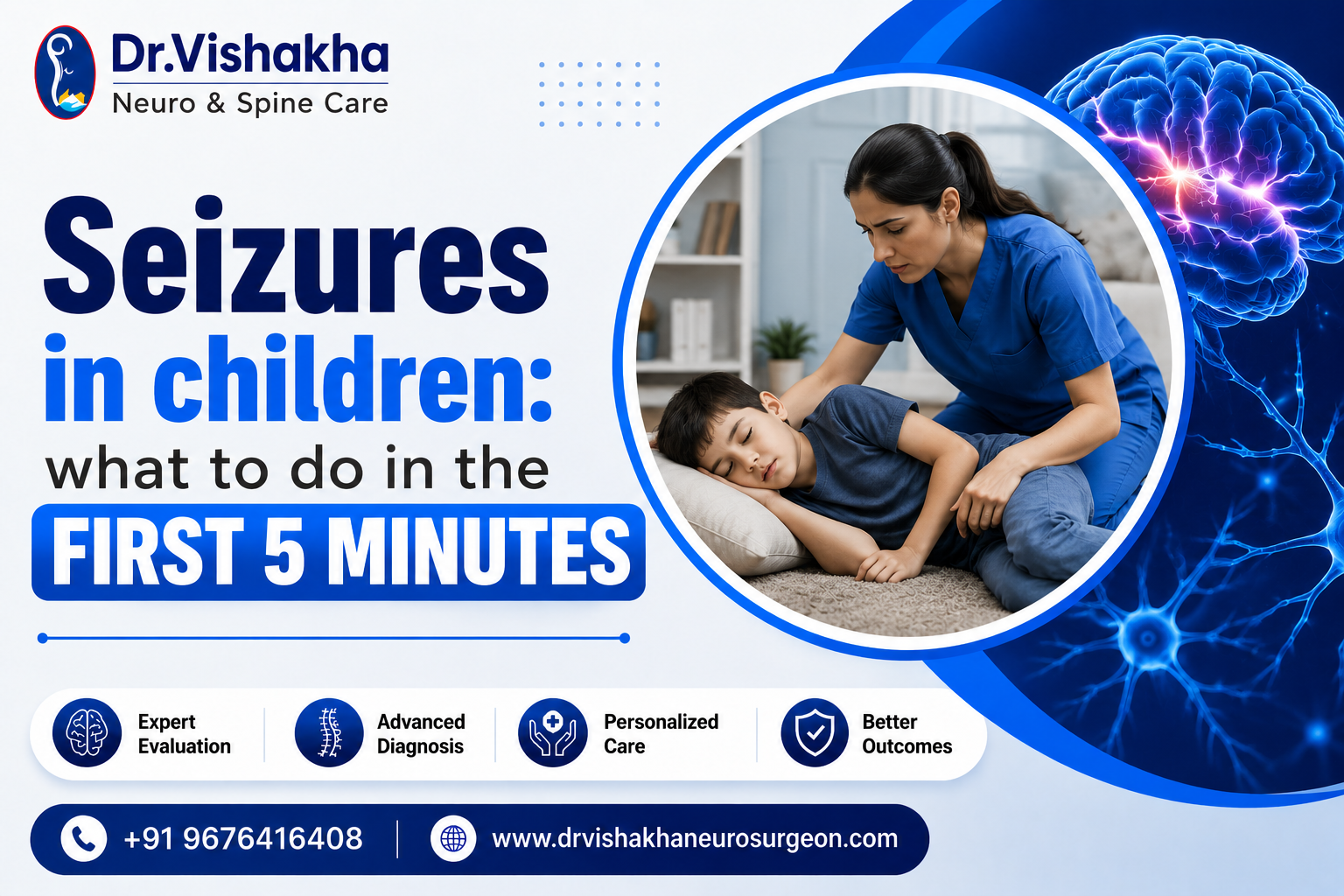
Seeing a child have a seizure is frightening, but the right response is simple. Good seizure first aid for children means helping the child down to the floor, turning them gently onto one side, moving hard objects out of the way, putting something soft under the head, and loosening tight clothes around the neck. Never put anything in the mouth. Never hold the arms and legs down. Look at the clock and note the time. Most seizures stop on their own in two to three minutes. If the seizure goes past five minutes, or the child struggles to breathe, call for emergency help at once.
What Is a Seizure?
It usually happens without warning. A four-year-old with a mild fever is watching television. Suddenly the body goes stiff, the eyes roll upwards, and the arms and legs start to jerk. For the next few moments, everyone in the room feels completely helpless. Almost every parent who has been through this says the same thing afterwards. They wish they had known what to do.
A seizure happens when the electrical activity in the brain becomes disturbed for a short time. The brain runs on tiny electrical signals. When a group of brain cells sends these signals suddenly and uncontrollably, the child may shake, go stiff, stop responding, or behave unusually. It can last a few seconds or a few minutes.
Families often miss that this is a sign, not a disease by itself. It tells us that something has upset the way the brain is working. The doctor’s job is to find out what that something is. It is also important to know that one seizure does not mean the child has epilepsy.
What Could It Look Like?
Many parents say the same thing later. They did not realise it was a seizure while it was happening.
That is because seizure symptoms in children can look very different from child to child. Some episodes are dramatic and easy to spot. Others are so short and quiet that they get mistaken for daydreaming, tiredness, or naughtiness.
Here is what a seizure can look like:
- The body suddenly goes stiff, or the arms and legs stiffen
- Jerking movements that you cannot stop by holding the arm or leg
- A blank stare for a few seconds, with no response when you call the child’s name
- Smacking the lips, chewing movements, or pulling at clothes again and again
- Eyes rolling up, or turning to one side and staying there
- The child suddenly goes limp and drops to the floor
- Blue or grey lips, drooling, or noisy breathing
- Passing urine without control
- Confusion, heavy sleepiness, or unclear speech afterwards
In babies, the signs are often much quieter. Cycling movements of the legs, odd flickering of the eyes, or short jerks that come in groups soon after waking up may be the only clue.
A simple test helps. If the child cannot respond to your touch or to their own name during the episode, take it seriously and tell your doctor.
Why Do Seizures Happen?
The cause often depends on the child’s age and on what was happening at the time.
| Cause | What goes wrong | Age group most affected |
| High fever | A fast rise in temperature upsets a young brain | 6 months to 5 years |
| Epilepsy | The brain has an ongoing tendency to misfire | Any age |
| Brain infection | Meningitis, brain fever, or a pocket of pus in the brain | Any age |
| Low levels in the blood | Low sugar, low sodium, or low calcium | Newborns and toddlers |
| Head injury | Bleeding, swelling, or a scar left after an injury | Any age |
| A problem in the brain’s structure | Extra fluid in the brain, a tumour, or a brain that formed differently | Any age |
| Injury around birth | Low oxygen supply during delivery | Newborns |
| Blood vessel problems | Moyamoya disease, stroke in children | Any age |
| Genetic conditions | Changes in genes, inherited or new | Early childhood |
Sometimes no clear cause is found even after all the tests. This is not unusual, and it does not mean the tests were a waste.
Types of Seizures in Children
Doctors group seizures by which part of the brain the activity starts in.
Focal seizures: They start in one part of the brain. The child may stay partly aware. You might see twitching on one side of the body only, or the child may report a strange feeling, taste, or sudden fear.
Generalised seizures: This involves both sides of the brain from the start. This includes:
- Tonic-clonic seizures: The body stiffens first, then jerks in a regular rhythm. This is the type most people picture.
- Absence seizures: A few seconds of blank staring, then the child carries on as normal. Teachers often mistake this for poor attention.
- Myoclonic seizures: Sudden, quick jerks, usually of the arms.
- Atonic seizures. The muscles suddenly lose power, and the child drops.
Febrile seizures: These happen along with a fever, usually between six months and five years of age. Most are short and do not cause any long-term harm, though they are very upsetting to watch. Febrile seizure first aid follows the same rules as for any other seizure. Turn the child on one side, put nothing in the mouth, and do not use a cold bath or heavy sponging while the child is still shaking.
Seizures in newborn babies and infantile spasms happen in the first weeks and months of life. These always need to be checked by a specialist quickly.
Conditions We Often See
In children’s brain surgery practice, a seizure is often the first sign of a problem inside the brain that a scan can pick up. The conditions we see most often are:
- Hydrocephalus. Extra fluid builds up inside the brain and raises the pressure.
- Brain and spine tumours. A first seizure is sometimes the very first symptom.
- Brain infections. Pockets of pus, tuberculosis in the brain, or scarring left behind after an infection.
- Head injury. Seizures can start soon after a fall or a road accident.
- Moyamoya disease and stroke in children. The blood vessels supplying the brain slowly become narrow.
- Craniosynostosis. The joints of the skull close too early, which can raise pressure inside the head.
- Spina bifida and encephalocele. The brain or spine did not form fully before birth.
Not every child needs surgery. But finding a problem that can be corrected, and finding it early, can change that child’s whole future.
What Should You Do in the First 5 Minutes?
This is the part every parent, grandparent, and teacher should know by heart. Once you know what to do during a seizure in a child, a helpless moment becomes a set of clear steps.
The first minute
- Look at the time. Check a clock or start the timer on your phone. How long the seizure lasted is the single most useful thing you can tell the doctor.
- Help the child down to the floor, away from stairs, roads, water, and furniture.
- Turn the child onto one side. This lets saliva run out of the mouth instead of collecting at the back of the throat.
- Support the head with a folded shirt, a cushion, or your hand.
- Clear the space around the child. Move away toys, spoons, hot drinks, and spectacles.
- Loosen tight clothing around the neck and chest.
Minutes two to five
- Stay with the child and speak in a calm voice, even if there is no reply.
- Watch the breathing, the colour of the lips, and which side of the body is moving. These details help the doctor.
- Record a short video if another adult is there. A video often tells the doctor more than any description can.
- Let the seizure finish on its own. Most stop within one to three minutes.
What you must not do
Good seizure safety for children is as much about what you avoid as what you do.
- Do not put anything in the mouth. No spoon, no cloth, no fingers. A person cannot swallow their tongue. Broken teeth and bitten fingers, on the other hand, are very real.
- Do not hold the arms and legs down or try to stop the shaking.
- Do not give water, milk, or medicine by mouth while the child is not responding.
- Do not let a crowd gather around the child.
- Do not put a child with fever into cold water.
When to Call an Ambulance for a Seizure
Knowing when to call an ambulance for a seizure takes the guesswork out of an already frightening moment. Call for help straight away in these situations.
| Situation | Why it matters |
| The seizure lasts more than five minutes | The child needs emergency medicine to stop it |
| A second seizure starts before the child wakes fully | The seizures may not stop on their own |
| Trouble breathing, or blue or grey lips | The child may not be getting enough oxygen |
| It is the child’s first ever seizure | The cause has to be found |
| It happened in water, or after a head injury | Risk of choking or bleeding inside the head |
| The child is under one year old | Needs to be seen the same day |
| The child got hurt during the seizure | Cuts and fractures need to be checked |
| The child does not wake up properly afterwards | Needs to be seen immediately |
If you are unsure, call. No emergency team will ever blame you for being careful.
What Happens Next?
Once the shaking stops, the child usually falls into a deep sleep. This is expected and does not mean the child is getting worse.
Recovery after a seizure in children usually follows the same pattern. The sleep can last from half an hour to a few hours. On waking, the child may be confused, tearful, or embarrassed. Headache and body aches are common. Sometimes one side of the body stays weak for a while before returning to normal.
What helps during this time:
- Keep the child lying on one side until fully awake
- Speak calmly and reassure them
- Do not give food or drink until the child is fully alert
- Write down how long it lasted, what you saw, what happened just before, and how the child was afterwards
A smooth recovery after a seizure in children also depends on follow-up. The doctor will usually arrange an EEG, which is a simple test that records the brain’s electrical activity, along with an MRI scan and blood tests where needed.
In the longer run, seizure safety for children is about a few sensible changes, not about wrapping the child in cotton wool. Supervise bath time and keep the bathroom door unlocked. Older children are safer with a shower than a bathtub. Use a helmet for cycling. Tell the class teacher and the grandparents exactly what to do. Protect regular sleep, because being overtired is one of the most common triggers.
Children do best when life stays as normal as possible. Too many restrictions can hold a child back far more than the condition itself.
Questions to Ask Your Specialist
Write these down and take them with you.
- What most likely caused this seizure?
- Which tests does my child need?
- Is this epilepsy, or a one-time event?
- Will my child need medicine, and for how long?
- What side effects should we watch for?
- Is there a problem inside the brain that surgery could correct?
- Should we keep emergency medicine at home, and how do we use it?
- Which activities need supervision?
- What should we tell the school?
- When should we come back for a review?
Frequently Asked Questions
- Can a seizure damage my child’s brain?
One short seizure rarely causes lasting damage. Longer seizures, past five minutes, carry more risk. That is why noting the time matters so much.
- Should I put something in my child’s mouth to stop tongue biting?
No. This is one of the most common and most dangerous myths. Correct seizure first aid for children never involves the mouth at all.
- My child had a febrile seizure. Will it happen again?
About one in three children have another one during a later fever. Most children grow out of it by five or six years of age. Controlling fever early and using correct febrile seizure first aid are the two things that matter most.
- Does one seizure mean my child has epilepsy?
Not necessarily. Epilepsy is diagnosed when a child has two or more seizures that happen without any clear trigger, more than a day apart.
- What if I am alone and panicking?
Take a breath. Recognising seizure symptoms in children and simply turning the child onto one side, away from anything hard or sharp, is most of what needs doing.
- Can my child play sports and swim?
Most children can, with an adult watching. For swimming, an adult should stay within arm’s reach. Ask your specialist about your own child’s pattern.
- When is surgery considered?
Surgery is considered when medicines do not control the seizures, or when a scan shows something that can be corrected, such as a tumour, extra fluid in the brain, a scar, or a blood vessel problem. A children’s brain surgeon can tell you whether surgery would help.
Conclusion
The first five minutes belong to you, not to the hospital. There will be no monitors, no medicines, and no doctors in the room. What you will have is a clear plan and the calm to follow it.
Turn the child onto one side. Protect the head. Note the time. Stay until it ends.
Seizure first aid for children needs no medical training. It needs a few correct actions done calmly, and a clear idea of when to pick up the phone.
If your child has had a seizure, even a short one that seemed to pass completely, get it checked by a specialist. Knowing what to do during a seizure in a child gives you a plan for the moment. Finding out why it happened gives you the answer for the long run.
Proficiency of Dr Vishakha – Neurosurgeries Expertise
Hydrocephalus (increased fluid in the brain): The procedure involves an endoscopic third ventriculostomy and CSF diversion (VP shunt) to treat complex hydrocephalus.
Craniosynostosis (abnormal head shape due to premature cranial suture fusion) surgeries: Helmet therapy is a technique that is used in both endoscopic and open surgery.
Spinal dysraphisms(Spina Bifida)– (spinal abnormalities present by birth) – surgical repair
Encephalocele repair surgery.
Vascular conditions and stroke surgeries: revascularisation surgeries for moyamoya disease.
Pediatric brain and spine tumour surgeries.
Pediatric brain and spine infection surgeries: Endoscopic and open surgeries for brain and spine infections.
Pediatric traumatic brain and spinal injury.
Antenatal counselling for congenital fatal neurosurgical conditions.
Related Links
Related treatment pages:
- Craniosynostosis: https://drvishakhaneurosurgeon.com/craniosynostosis/
- Pediatric Neurosurgery: https://drvishakhaneurosurgeon.com/pediatric-neurosurgery/
- Hydrocephalus: https://drvishakhaneurosurgeon.com/hydrocephalus/
- Antenatal Counselling: https://drvishakhaneurosurgeon.com/antenatal-counselling/
Other blog posts:
- Spina Bifida Journey: From Antenatal Diagnosis to Postnatal Repair: https://drvishakhaneurosurgeon.com/spina-bifida-journey-from-antenatal-diagnosis-to-postnatal-repair/
- Understanding Your Baby’s Milestones: How Brain & Spine Health Plays a Crucial Role: https://drvishakhaneurosurgeon.com/understanding-your-babys-milestones-how-brain-spine-health-plays-a-crucial-role-dr-vishakha/
- Is Your Baby’s Soft Spot Normal? Here’s How to Tell: https://drvishakhaneurosurgeon.com/is-your-babys-soft-spot-normal-heres-how-to-tell-dr-vishakha-explains/
Book a Consultation
If your child has had a seizure, an early specialist opinion gives you clarity and a clear way forward.
Consult Dr Vishakha Basavraj Karpe, one of Hyderabad’s leading children’s brain and spine surgeons.
Phone: +91 8618978597, +91 9676416408 Website: drvishakhaneurosurgeon.com Locations: Rainbow Children’s Hospital, Banjara Hills and Hydernagar, Hyderabad
Book your consultation today.
This article is for general awareness and does not replace a personal medical check up. In an emergency, contact your local emergency services immediately.